The State of Link Building Pricing in 2026: What Bazoom’s Publisher Network Reveals
Jump to section [Open]
Most pricing guides are opinion. This one is data. We pulled placement costs from across Bazoom’s 80,000+ publisher network — segmented by niche, geography, and DR tier — to show you what link building actually costs in 2026.
Everyone has an opinion about what a backlink should cost. Agencies will tell you to expect $300–$1,500 per placement. Freelancers will quote you $80 and call it a bargain. PBN sellers will offer you 10 links for $200 and wonder why you’re not excited.
None of those numbers come from actual market data. They come from pricing pages and gut feel.
We decided to do something different. Bazoom operates a marketplace of over 80,000 media outlets across 65+ markets. We know what publishers are charging — not what agencies want to charge their clients, but what real editorial placements actually cost at the source. So we pulled the numbers.
Here’s what link building pricing actually looks like in 2026 — broken down by niche, region, and DR tier.
Why Link Building Pricing Is So Confusing (And Who Benefits From That)
The link building industry has a transparency problem. Pricing is intentionally opaque because opacity is profitable — for intermediaries.
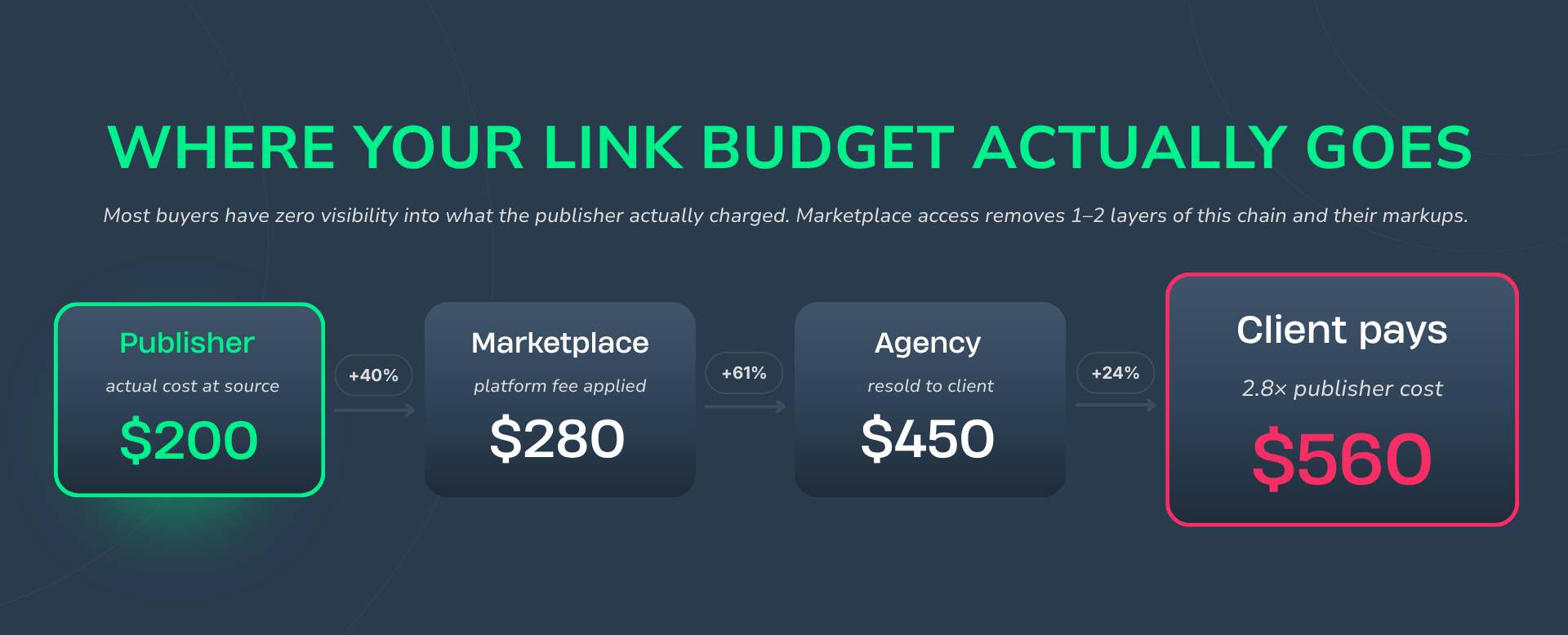
Most clients have no reference point for what a link should cost, so they rely on whatever the agency tells them. The agency, in turn, marks up marketplace pricing by 40–200% without disclosing the source publisher.
The result: buyers consistently overpay or, worse, underpay for junk links because they have no benchmark.
What actually determines a fair price? Three things:
- The niche (competitive verticals command a premium)
- The domain’s DR, organic traffic, and editorial quality
- The geography of the target market
Let’s look at each of these with real numbers.
Link Building Pricing by Niche: The Premium Verticals
Not all niches are created equal. Publisher pricing correlates strongly with the commercial value of the traffic — which means iGaming, finance, and crypto placements cost significantly more than lifestyle or general editorial.
The Premium Tier: iGaming, Finance, Crypto
Across the Bazoom network, placements in iGaming, online casino, and sports betting consistently occupy the top of the pricing stack. These are markets where a single converting user can be worth hundreds of dollars in lifetime value, which publishers understand very well.
Average placement costs in these niches:
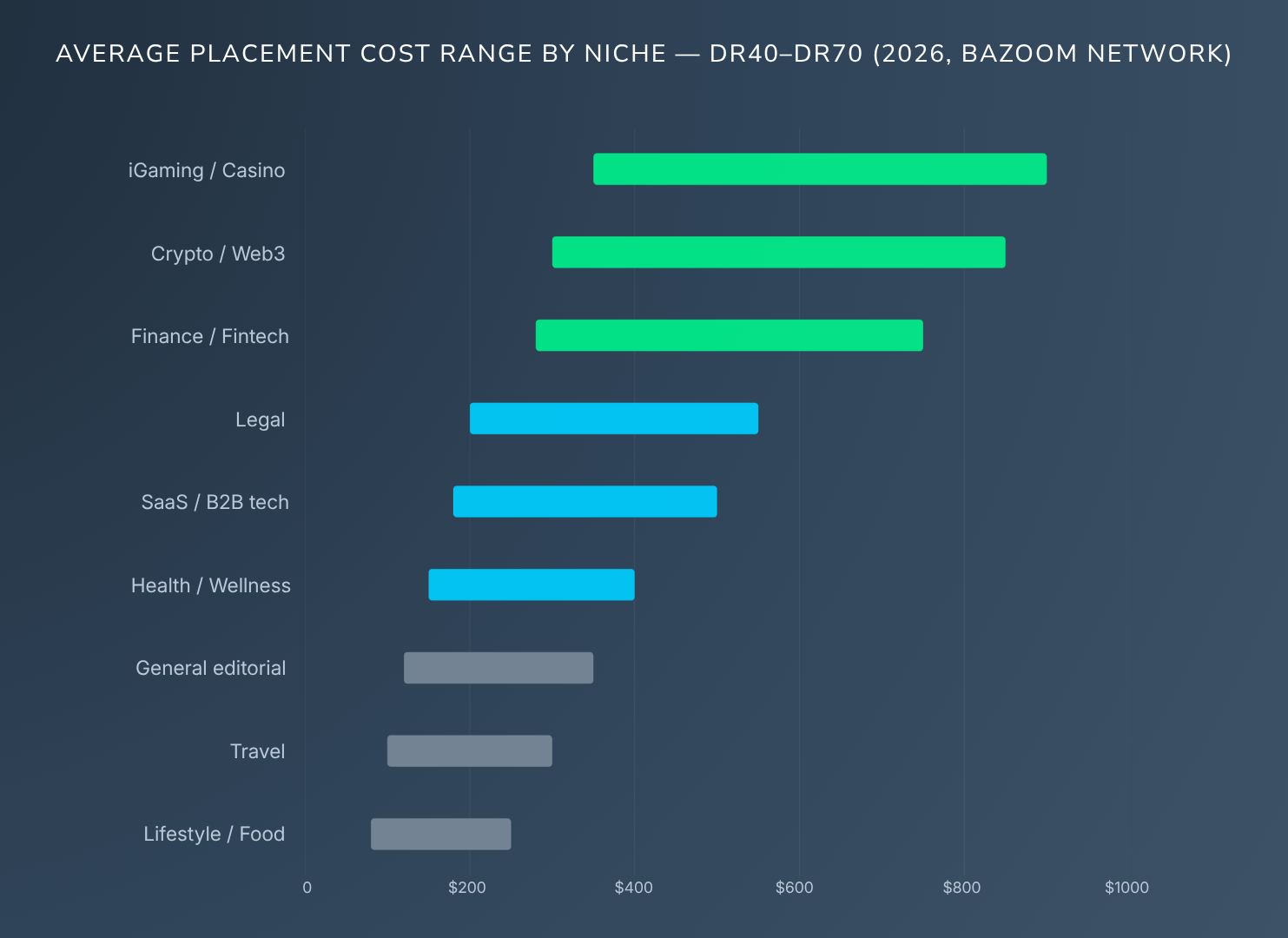
- iGaming / Casino: $350–$900 per placement (DR40–DR70 range)
- Finance / Fintech: $280–$750 per placement
- Crypto / Web3: $300–$850 per placement — with significant variance based on editorial stance
The upper end of these ranges applies to tier-1 publishers with meaningful organic traffic and strict editorial standards. Anyone quoting you DR70 casino links for $100 is selling something that has no organic readership — and Google knows it.
The Mid-Tier: SaaS, Health, Legal
SaaS and B2B tech fall into an interesting middle ground. The domains are often strong (many are genuine industry publications), but the supply side is healthier, which moderates pricing.
- SaaS / B2B tech: $180–$500 per placement
- Health / Wellness: $150–$400 per placement (with YMYL complexity)
- Legal: $200–$550 per placement
YMYL (Your Money or Your Life) niches in health and legal carry editorial friction — publishers are rightly cautious — which can push turnaround times up and, for genuinely good sites, pricing along with them.
The Accessible Tier: Lifestyle, Travel, General Editorial
This is where the volume market lives. Publisher supply is large, competition among link sellers is fierce, and pricing reflects that.
- Lifestyle / Parenting / Food: $80–$250 per placement
- Travel: $100–$300 per placement
- General news / editorial: $120–$350 per placement depending on DR
These niches offer the best value for brands that don’t need niche-specific context — topical authority for a SaaS company or a general brand building campaign.
Link Building Pricing by Geography: What Your Target Market Costs
This is where most pricing guides stop. They give you global averages and call it done. But geography is one of the biggest pricing levers in link building — especially if you’re running multilingual or multi-market campaigns.
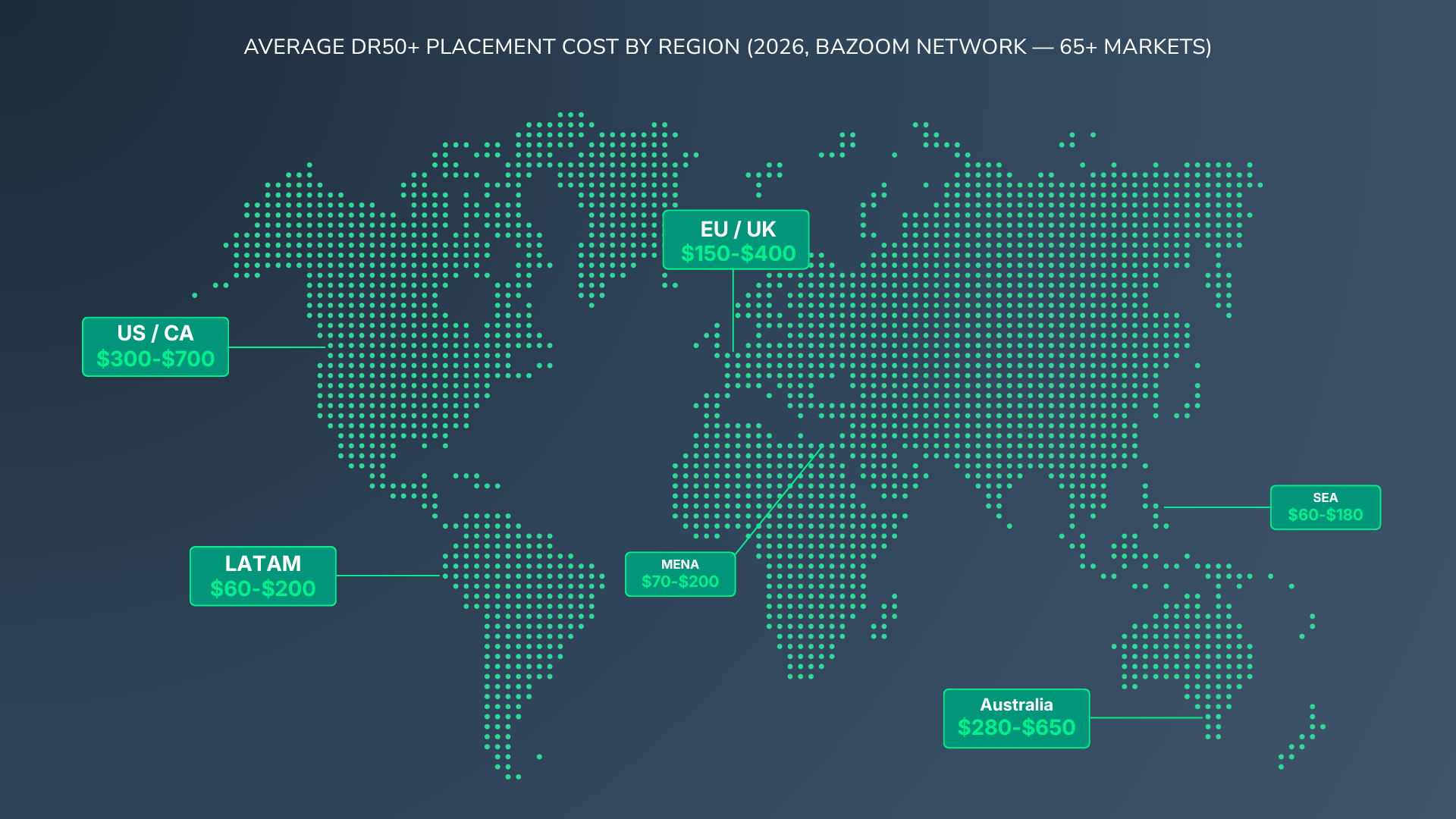
Bazoom operates active publisher networks across 65+ markets. Here’s what we see:
Tier 1 English Markets (US, UK, AU, CA)
These are the most competitive markets with the strongest demand from buyers — and pricing reflects it. DR50+ placements in core English markets from genuine editorial publishers typically run $300–$700+. The US market specifically commands a premium of roughly 20–35% over equivalent UK placements.
Western European Markets (DE, FR, ES, IT, NL)
Western Europe offers a useful arbitrage window. Publishers in Germany, France, and Benelux are strong editorially, but buyer demand from non-European brands is lower, which moderates pricing. Expect $150–$400 for equivalent DR placements compared to US/UK equivalents at $300–$700.
One caveat: don’t conflate lower price with lower quality. A DR55 German finance publisher with 40k monthly organic visitors is a strong link for any client targeting DACH markets — and it will cost you less than a weaker US equivalent.
Emerging Markets (LATAM, SEA, MENA)
For clients targeting Brazil, Mexico, Southeast Asia, or Gulf markets, link building pricing looks very different — and so does publisher quality variance.
Average placement costs in these regions run $60–$200 for mid-DR publishers. The challenge is that publisher quality control requires local knowledge. Organic traffic patterns, editorial standards, and spam risk all look different in markets where the link economy is less mature.
Bazoom’s native-market sourcing approach — using regional teams to vet publishers directly — is what makes this tier workable at scale. We’ve seen too many campaigns fail in emerging markets because buyers sourced from international marketplaces without local quality validation.
Link Building Pricing by DR Tier: The Real Price-Per-DR Math
DR (Domain Rating) is an imperfect but widely used proxy for link value. Here’s how pricing maps onto DR tiers across the Bazoom network, averaged across niches:
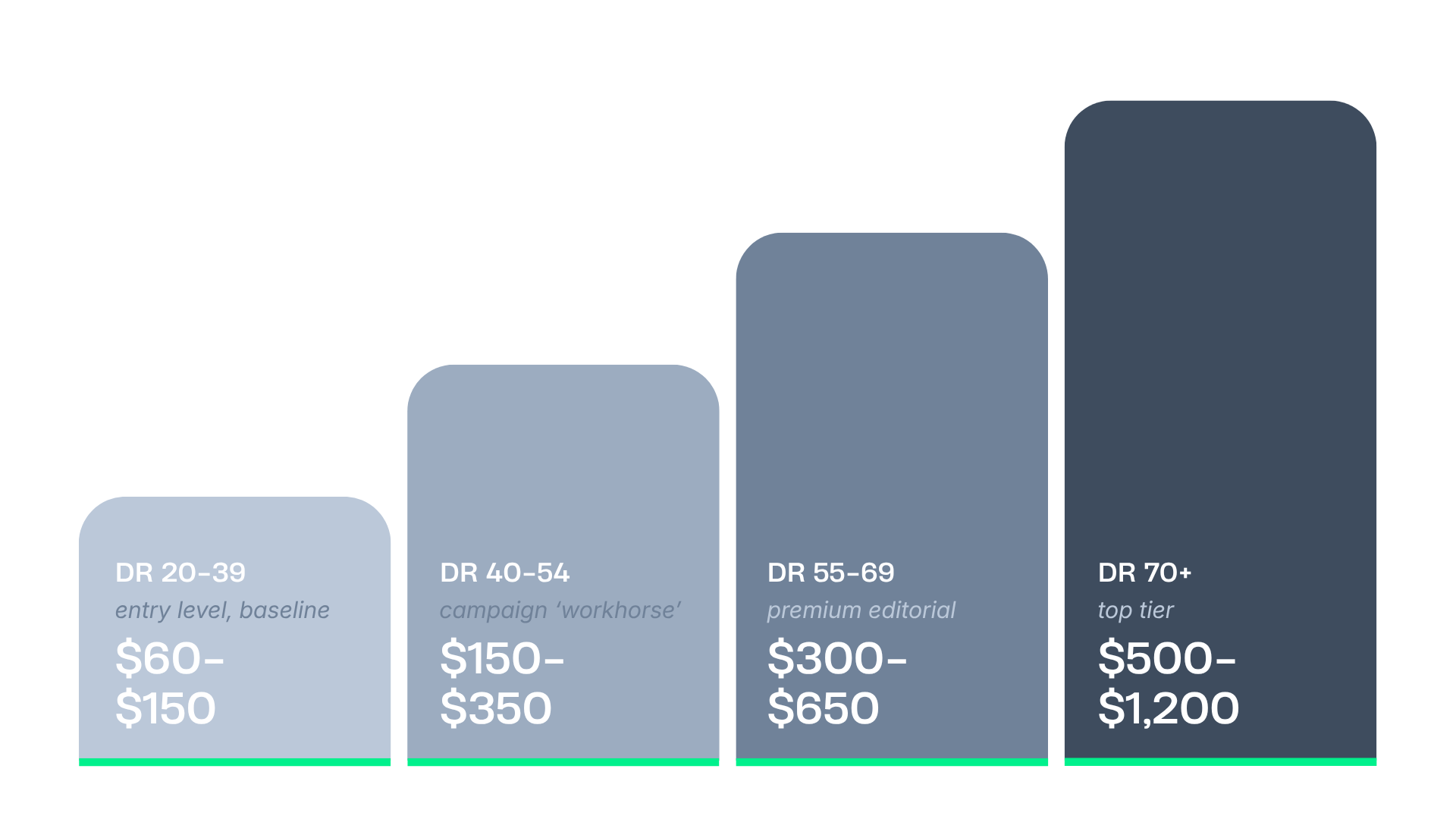
- DR 20–39: $60–$150 | Entry-level; useful for fresh domains building profile breadth
- DR 40–54: $150–$350 | The workhorse range for most campaigns
- DR 55–69: $300–$650 | Premium tier; strong traffic correlation at this range
- DR 70+: $500–$1,200+ | Top-tier editorial placements; high scrutiny, high value
A critical note: DR alone doesn’t determine link value. A DR60 site with 500 monthly organic visitors is not the same as a DR60 site with 150,000. Traffic quality and editorial standards matter enormously — and these factors aren’t visible in a DR number.
This is why campaigns built purely on DR thresholds underperform. Real publisher evaluation requires traffic data, editorial audit, content recency, and topical relevance — not just a third-party metric score.
What’s Driving Price Increases in 2026
Link building pricing has moved upward across most niches since 2024. There are three structural reasons for this:
1. Publisher Consolidation
The supply of genuinely high-quality editorial publishers has not kept pace with buyer demand. Many mid-tier sites that would previously accept sponsored content have tightened standards or stopped accepting placements altogether — partly due to Google’s increasing scrutiny of paid link signals, partly due to HCU volatility making publishers cautious about monetisation patterns.
2. Niche Compliance Overhead
In regulated verticals — iGaming, finance, crypto — publishers increasingly require content compliance review, jurisdiction verification, and sometimes legal sign-off. This editorial friction is real and it adds cost. It also explains why the cheapest option in these niches is almost always a red flag.
3. AI Content Saturation
The flood of AI-generated content has made editorial gatekeepers more selective, not less. Publishers that maintain genuine standards are now explicitly filtering for this — which reduces the volume of sites willing to publish sponsored content and concentrates demand at the quality end of the market.
The Takeaway: What You Should Actually Be Budgeting
The ‘right’ budget for link building depends entirely on your market, niche, and competitive landscape. But based on Bazoom network data, here’s a realistic framework for 2026:
- 10–15 links/month in a competitive niche (finance, iGaming): $4,000–$10,000+
- 10–15 links/month in a mid-tier niche (SaaS, health): $2,500–$6,000
- 10–15 links/month in a general/lifestyle niche: $1,200–$3,500
Campaigns that fall significantly below these ranges are typically achieving one of two things: buying low-quality links that won’t move rankings, or buying from marketplaces with heavy markup that’s not reflected in publisher quality.
The uncomfortable truth about link building pricing is that the market broadly gets what it pays for — but not always what it thinks it’s paying for. Knowing actual publisher costs is the only way to evaluate whether an agency’s pricing reflects quality or margin.
The Bottom Line
Link building pricing in 2026 is not a single number. It’s a function of niche, geography, DR tier, and editorial quality — and understanding the interplay between these variables is what separates campaigns that compound in value from those that generate reports without rankings.
Bazoom’s publisher network data tells a consistent story: quality links at fair prices exist, but you need market visibility to find them. Generic pricing guides give you averages. The Bazoom marketplace gives you the underlying data.
If you want to see what placements in your specific niche and target markets actually cost — with real publisher metrics, not ballpark figures — you can explore the Bazoom marketplace directly or book a strategy call with our team.