7 New Backlink Types on Bazoom: Built for 2026 Search

Jump to section [Open]
If you’ve been buying the same backlink type since 2019, your link profile probably looks like everyone else’s. Articles, articles, more articles. Maybe a niche edit if your agency is feeling spicy. That worked when Google was the only judge in the room. It doesn’t work now.
We just rolled out seven distinct backlink types in the Bazoom marketplace, and I want to be honest about why.
The surface-level pitch (“more options!”) buries the actual point.
The actual point: a profile of 100% guest article backlinks is a fingerprint.
Algorithms read fingerprints. So do manual reviewers. So, increasingly, the systems are deciding whether to cite your brand in an AI answer. None of those judges think “wow, look at this consistent editorial outreach.”
They think: this looks built.
Here’s what’s now live, and what each backlink type is actually for.
Article: A fresh piece written around your link, published on the publisher’s site. The classic backlink format. Still works. Should not be 90% of your strategy.
Link insertion: Your link goes into a post that’s already indexed and already has some history with Google. You inherit that history. Faster to move the needle on a specific page than waiting 3 to 6 months for a new article to mature.
Brand mention: Your brand named in a piece, with or without a clickable link. The unlinked version is the one most people sleep on. Google has been parsing entity mentions for years. AI systems lean on them even harder, because they’re aggregating across the open web instead of following a hyperlink graph.
Homepage: Backlink sits on the publisher’s front page. Most authoritative URL on any domain, by definition. Works hardest for branded anchors, partnership-style placements, or campaigns where you actually want to be associated with the publisher openly.
Sitewide: Header or footer placement, every page of the domain. Big footprint. Niche match has to be tight or it’s a bad use of money.
Native: Paid-style reach with editorial framing. Good when you need impressions plus a credible context, not just a referring domain in your Ahrefs export.
PR article: Journalist-voiced coverage built for trust signals and brand authority. The kind of backlink LLMs read like “this brand is real and gets covered.”
Where to find the new backlink types in the marketplace
If you’re already using Bazoom, here’s how to filter and order each of the seven backlink types.
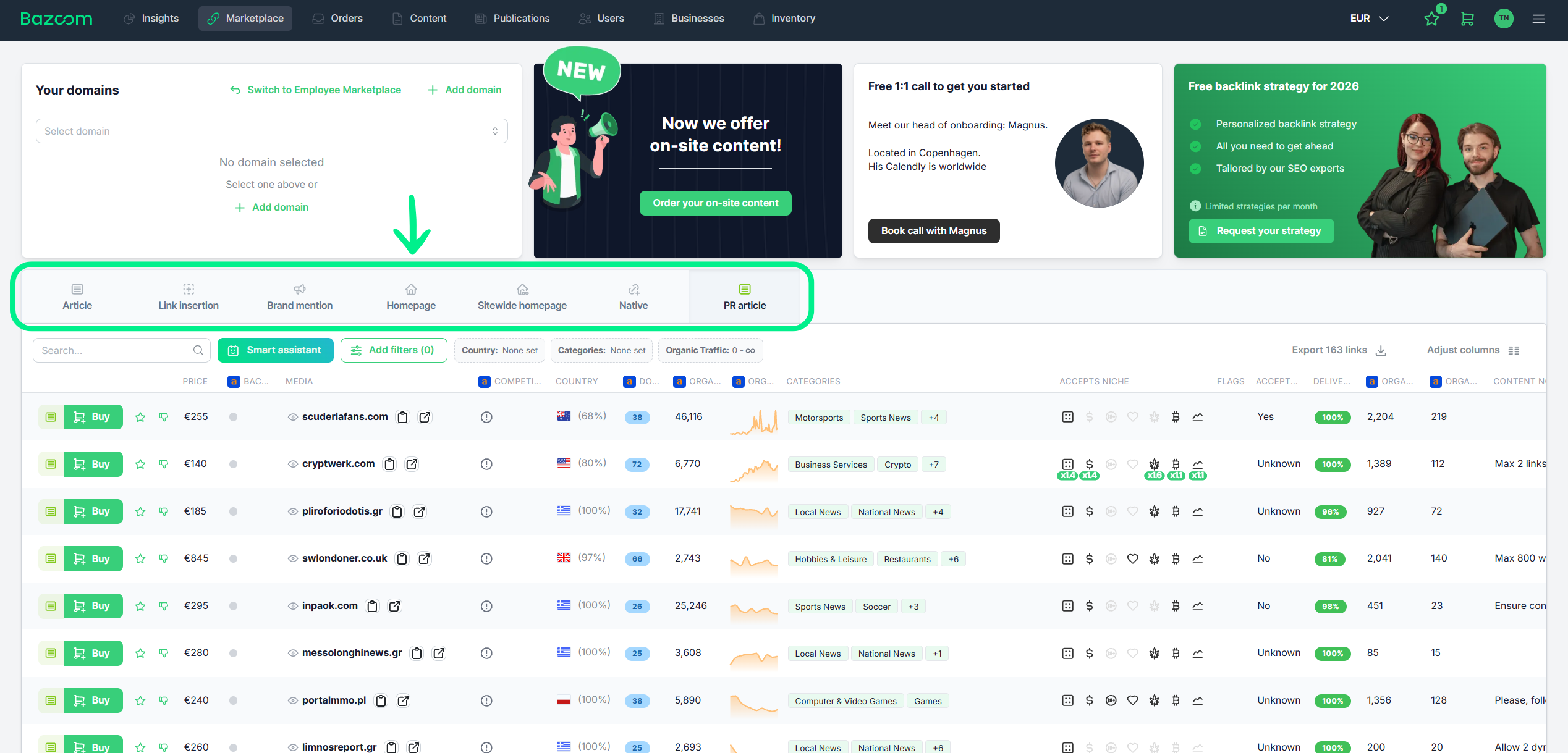
Open the marketplace and browse through the backlink types above the publisher list.
All seven options sit there: Article, Link insertion, Brand mention, Homepage, Sitewide, Native, and PR article. Select one or stack multiple to compare publishers across formats.
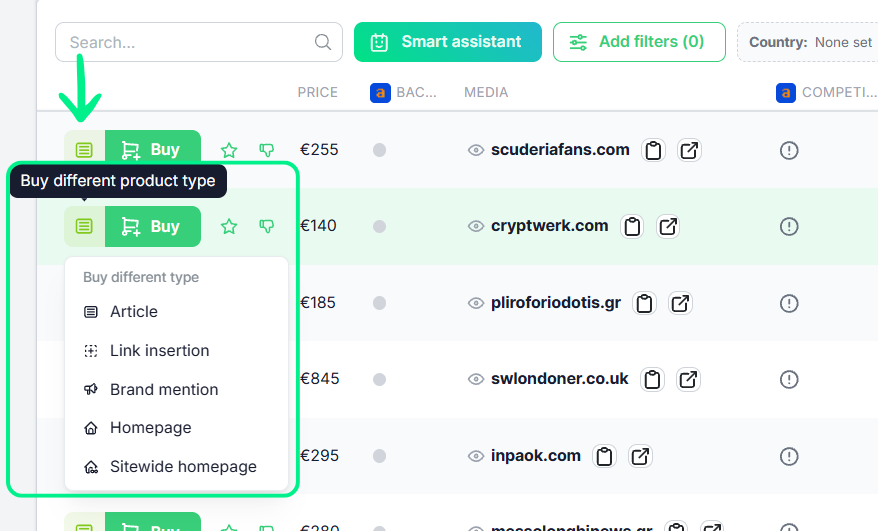
Each publisher shows the formats they support and pricing per format on their card.
Domain rating, traffic, and niche stay the same across formats; only the placement type and price change.

When you place an order, the link type is selected at the brief stage. For Article and PR placements, you’ll add a topic or angle. For Link insertion, you provide the target URL on the publisher’s site if you have one in mind, or let the publisher suggest one. For Brand mention, you specify whether you want a link or an unlinked citation.
A few quick notes from the team:
- Link insertion turnaround is faster than Article. If you have a campaign with a tight deadline, this is the format to lean on.
- PR articles need more lead time. Journalist-style placements take longer to draft and place. Plan 2 to 3 weeks minimum.
- Sitewide and Homepage are limited inventory. These are negotiated with each publisher and don’t scale the same way editorial formats do. Reach out to your account manager if you want help sourcing them.
If you can’t find the format you need on a specific publisher, the support chat in the bottom right can usually surface alternatives in the same niche.
Why these backlink types matter specifically right now
The job changed. Six months ago, a backlink was a vote for a page. Today, a backlink is a vote for a page AND a data point for AI systems trying to figure out whether your brand exists, what you do, who agrees, and who’s quoting you.
Those two jobs need different signals. PageRank is monolithic — it flows through hyperlinks, and that’s it.
AI citation logic is messier. ChatGPT, Perplexity, and Google’s AI Mode are pattern-matching across mention frequency, surrounding context, source diversity, and entity co-occurrence. A homepage backlink, a PR mention, and an unlinked brand citation in a niche blog all feed different parts of that pattern.
If your only signal is “we got mentioned in 40 niche blog posts this quarter,” you show up as one type of evidence. If it’s 20 articles + 5 PR placements + 8 brand mentions + 2 homepage features + a sitewide partnership, you show up as a brand that exists in the wild. Those two backlink profiles trigger different things. Increasingly, only one of them gets cited.

The part nobody wants to say out loud
Backlink diversity is also just harder to fake. That’s part of why it works. Anyone can scale guest posts. Scaling real PR coverage, earning a homepage feature, getting cited by name without a link, these things require enough actual brand presence that gaming them is expensive. Google knows this. AI systems are starting to behave like they know it too.
So when we say diversity protects your profile, we don’t mean diversity is nice for variety. We mean profiles that look earned outperform profiles that look bought, and the only way to look earned is to actually use the backlink types earned profiles contain.
How we’d suggest using these backlink types
Don’t split evenly. That’s a different kind of fingerprint. Match the backlink type to the job:
Articles and link insertions for topical relevance and rankings on specific pages. Brand mentions and PR for entity strength and AI citation surface area. Homepage and sitewide backlinks for selective authority plays where the publisher fit is genuinely strong. Native when you need reach with a credibility halo.
All seven backlink types are live now in the Bazoom marketplace. If you want help mapping them against an actual campaign, the team’s around.