Link Velocity: How Fast Should You Build Backlinks in 2026?
Jump to section [Open]
Most link building advice skips the most obvious question: how fast is too fast? Build too slow and you lose topical momentum. Build too fast and you hand Google a penalty trigger on a platter. Link velocity (the rate at which a site acquires backlinks over time) is one of the most misunderstood levers in SEO. In 2026, with AI search systems adding new dimensions to how authority is assessed, getting this calibration right matters more than it used to.
Natural vs. Accelerated Velocity: What’s Actually the Difference?
Natural link velocity looks messy. Real editorial links don’t arrive in neat weekly batches. They spike around content launches, PR moments, and trend cycles, then flatten. Accelerated velocity, when done wrong, looks suspiciously clean: the same volume every week, often from the same type of site.
The issue is not speed. It’s pattern. Google’s link graph analysis is sophisticated enough to distinguish organic spikes from manufactured drip campaigns. What you’re actually optimizing for is unpredictability within a plausible range.
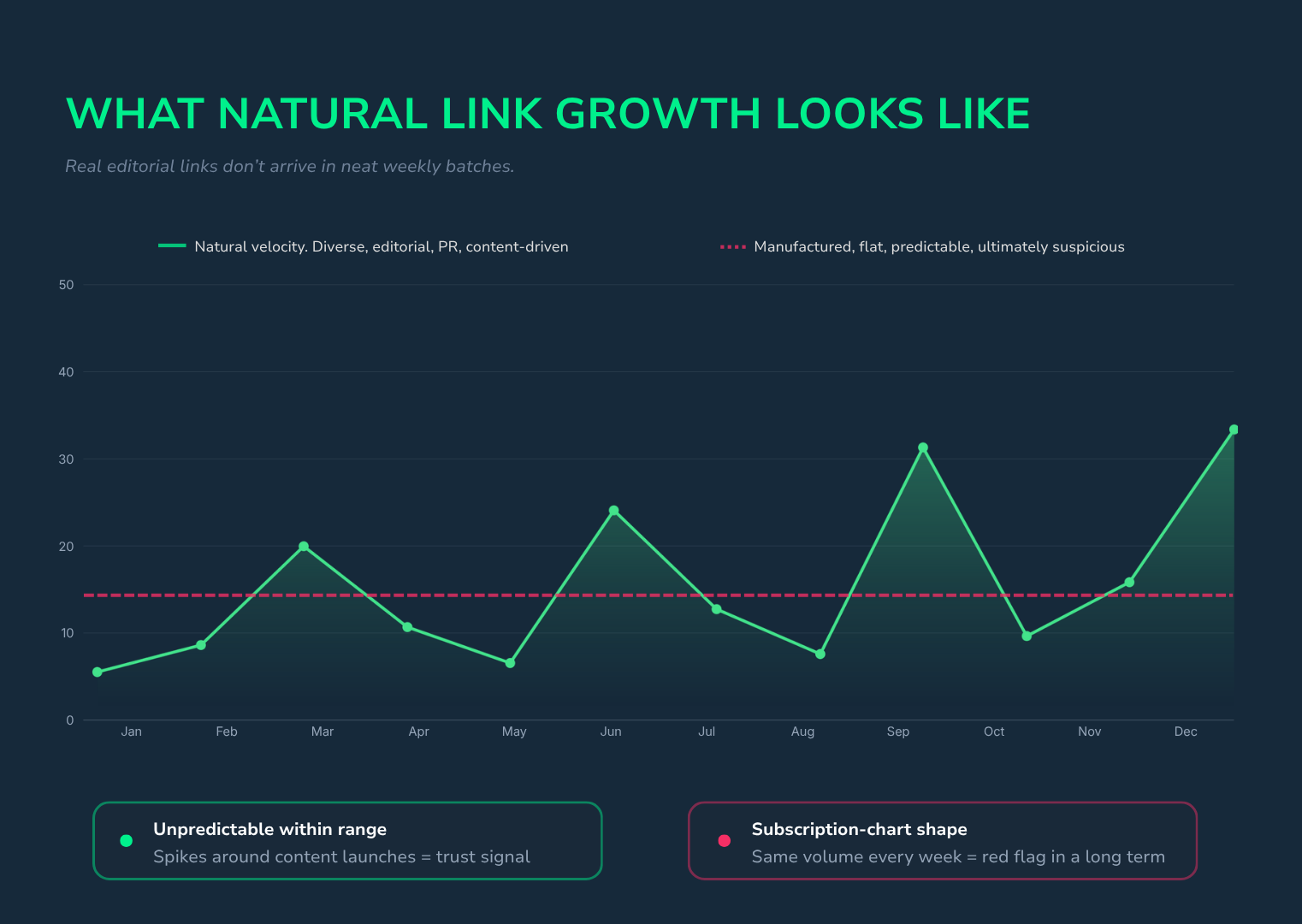
If your link acquisition graph looks like a subscription billing chart, something is off.
Domain Age Changes Everything
A 3-month-old domain acquiring 40 links per month will look very different from a 6-year-old domain doing the same. Domain age sets the baseline expectation for how fast a site should be growing.
For newer domains (under 12 months), keep it conservative — 5 to 15 links per month is a defensible range. Focus on foundational links: citations, brand mentions, one or two editorial placements. The goal is establishing a pattern, not rushing authority.
For established domains with 2+ years and 200+ existing referring domains, you have more room to accelerate. You can push 30 to 60 links per month in competitive verticals without raising flags, provided source diversity and anchor text ratios stay clean.
In high-churn verticals like iGaming, crypto, or finance, the ceiling is higher but so is the scrutiny. These industries are heavily monitored for manipulative patterns, which means velocity needs to be backed by site quality, not just volume.
How to Benchmark Against Competitors
The fastest way to find your target velocity range is to study what already works. Pull the referring domain growth of your top 3 to 5 organic competitors using historical RD data. Look for:
- Average monthly RD growth over the past 6 months
- Spike-to-baseline ratio — how dramatic are their link surges?
- Link type distribution — editorial vs. niche placements vs. directory
If competitors average 25 new referring domains per month and rank on page one, that is your floor, not your ceiling. You need to match that baseline before outpacing it.
Bazoom’s Internal Framework
When planning a link building campaign at Bazoom, we run a four-step velocity check before scaling:
- Baseline audit — current RD count, DR, and 90-day growth trend
- Competitor benchmark — target range based on top 5 organic competitors
- Domain age adjustment — reduce target by 40% for domains under 18 months
- Anchor text budget — exact-match anchor stays below 10% of total monthly links
This keeps campaigns scalable without creating a pattern that looks synthetic, and gives clients a clear, defensible rationale when we report results.
The Practical Decision Framework

Link velocity is not about going fast. It is about going at the right speed, consistently, in a way that matches your site’s trust profile and competitive context.
Speed without strategy is just noise.