Establishing your backlink profile

Jump to section [Open]
What is a backlink profile?
A website’s backlink profile is the total number of backlinks to your site, often analyzed by SEO tools and professionals. Consider it your web reputation map. All links, including referring domains, are votes of confidence that signal to search engines your content is credible and worth ranking.
Properly maintained and balanced SEO, as part of your SEO strategy and SEO backlink profile, helps your site build a healthy backlink profile. It will help you rise the ranking ladder, attract more organic visitors, and be recognizable in a competitive online environment. And the great news? You do not need to do everything by hand.
If you are not just interested in increasing visibility and gaining long-term authority, you will need to improve your backlink profile. Would you like to build your backlink strategy on day one with high-quality backlinks? Then explore the fantastic link opportunities Bazoom offers.
Breaking down key components of a backlink profile
But what comprises a healthy backlink profile? And what is a backlink profile? Several elements work together to attract search engines’ attention to your website. And to other websites that link to it.

First, you must have incoming backlinks. Not just lots of links in a single place, but a solid selection of respectable sites containing links to you. This is where profile link building, including branded anchor text, would help diversify the sources of such links.
Second, is anchor text diversity. A healthy mix of branded words, generic expressions (e.g., “click here”), and keyword-rich anchor texts can mimic natural growth.
Thirdly, there is topical relevance. An industry giant’s backlink profile is worth much more than a niche profile’s.
Here is where our team can help you. Site owners can filter opportunities by niche, authority, language, and country to ensure they are acquiring high-quality backlinks.
Using the tracking tools provided by Bazoom, you can continue growing your links safely, ensure link quality, and track your progress.
Browse our Bazoom platform and the array of niche publishers to enhance your link profile.
How search engines evaluate backlink profiles
You need to understand how Google judges your links to accrue sustainable ranking power. Fundamentally, the backlink profile definition is based on three priorities:
- Authority
- Quality
- Organic Growth
But what is a backlink profile in the context of search results? SEO-driven search engines like Google favor quality and relevant backlinks that enhance your search engine results pages. This can improve your search rankings, especially those with high domain authority, as compared to low-end links.
For example, Google analyzes where your links originate and whether they appear natural or suspicious. The algorithm is like your friend who knows the answer to everything and can identify unnatural behaviour, including spammy links, so shortcuts won’t help much.
That is why we want you to learn the difference between authentic authority links and hazardous link schemes. Earned links that are natural help in your company’s backlink profile credibility, whilst links that are generated through paid links and those that are toxic links may penalize your site.
Here at Bazoom, we can help you spot risky patterns early and keep your backlink profile aligned with the best SEO practices.
Securing high-authority referrals for maximum value
Not every backlink is equally valuable, and the meaning of a backlink profile can vary. Some are priced much higher than others, particularly when they have authorities such as a large-edition newspaper or a blogger, a college or university, or even a state site.
These connections, unlike low-authority links, are heavyweight trust signals that signal to search engines that your website is credible enough to act on and to determine what a good backlink profile looks like.
Then what constitutes a strong backlink profile? One with a healthy number of high-authority endorsements. Establishing relationships with reputable websites may take the form of guest posts, interviews, expert posts, or collaborative findings. Imagine it as purposeful networking: You are both building valuable links to your audiences while enhancing your reputation in the domain.
This is where your link building plan comes into play. It does not happen by chance that a good backlink profile is created; it requires a roadmap.
Bazoom does this with ease by connecting you with verified, high-quality publishers that match your niche and SEO interests. Rather than cold emailing hundreds of sites, you can secure placements that actually move the needle in the Bazoom marketplace.
Avoiding and handling low-quality links
As much as good links boost your SEO backlink profile, bad links can do the opposite. Spammy, irrelevant, or toxic backlinks can cause a ranking decline or, in severe cases, result in manual penalties from Google. These unsafe links are usually generated by link farms, irrelevant sites, or automated tools that spray your URL on low-quality pages.
This is why maintaining a strong backlink profile is so important to you, especially compared to your competitors’, and should be a priority.
Now, for the question-and-answer: “What is a backlink profile?” It is clean and relevant, built over time, not full of low-quality or junk content.
Also, conduct (monthly or quarterly) inspections to maintain your backlink profile, including sitewide links, in search engines, and avert future ranking issues.
Keep toxic links under control with our platform’s monitoring capabilities, which can serve as a backlink profile checker to ease your concerns.
Monitoring and measuring backlink profile success
It is equally vital to track progress and build links when answering the question of what backlink profile success is.

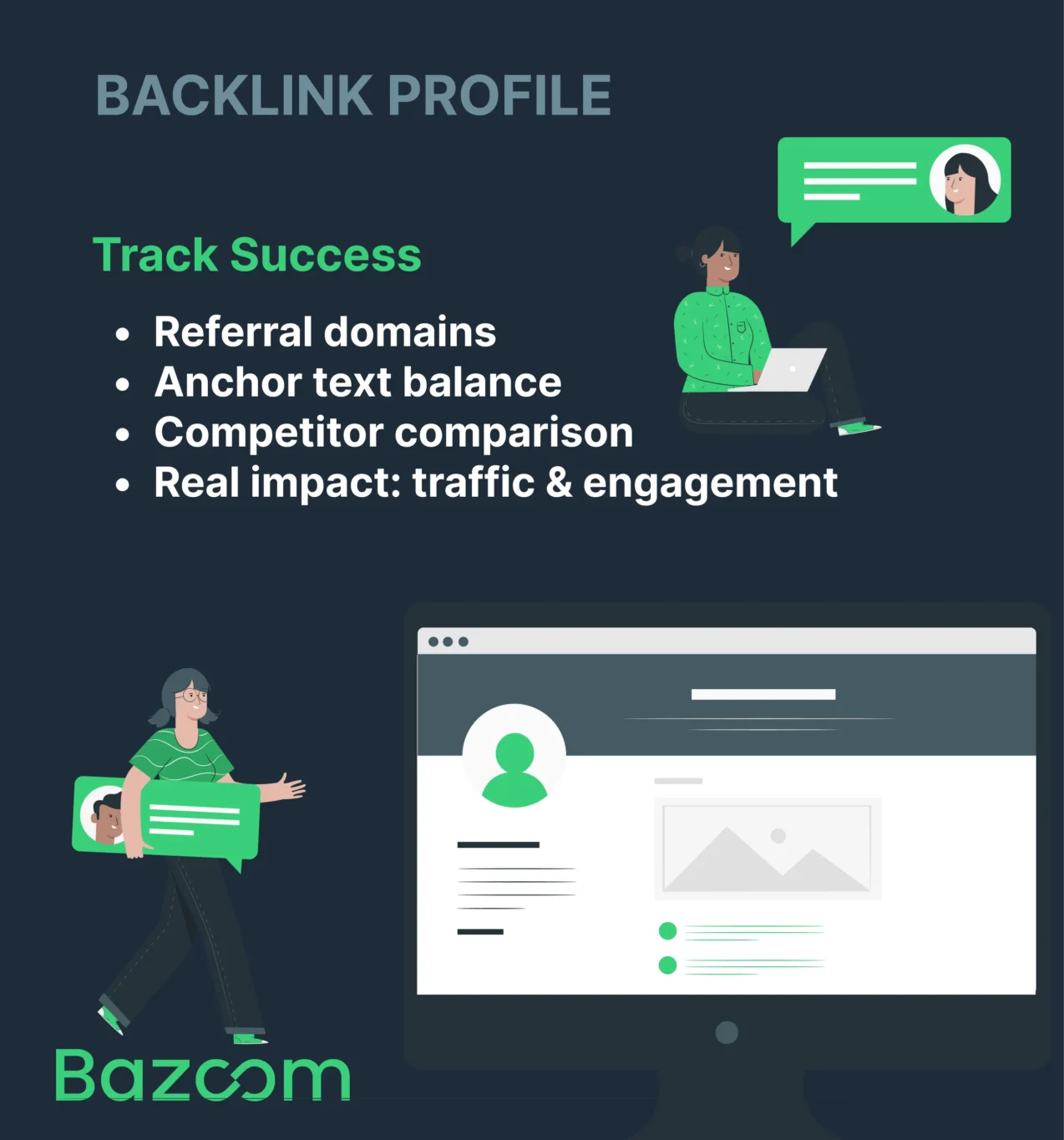
To clearly see whether what you are doing to develop profile backlinks is bearing fruit, consider various SEO backlink profile metrics. You will desire to track down a few key indicators, including spam scores.
- Begin with referral domains: Is the number of referrals increasing?
- Check your anchor text diversity to ensure it is natural and well-balanced
- Compare your backlink profile’s performance over time with that of your top-ranking competitors
- Do not overlook real-world impact. Strong indicators of a working link strategy are higher conversions, improved engagement, and referral traffic
Bazoom simplifies the process and makes backlink profile definition easy to understand, keeping your business up to date and helping you adjust your approach.
Building a resilient link strategy for long-term SEO
Did we answer your question of what a backlink profile is? A good backlink profile isn’t built in a day. Creating a daily routine of acquiring new backlinks, intelligent sourcing, and adherence to SEO best practices is what makes a solid backlink profile.
Thoughtful sourcing and devotion to SEO best practices. The purpose is to build backlinks on relevant, high-quality sites, not to take shortcuts or to prioritize continuous growth over high growth.
Develop a link building plan that includes your objectives, target link locations, desired anchor text, and the desired monthly link count. Focus on genuine relationships and long-term partnerships. Keep in mind that it is essential not only to acquire new links but also to maintain a clean backlink profile.
With Bazoom, it is much easier to develop a strong, solid strategy. Build profile backlinks that are considered valuable and withstand the test of time.
When you lay out a sound strategy for building new backlinks with Bazoom, you build your brand, boost rankings, and establish long-term online legitimacy.