Check spammy backlinks: A guide to effective SEO

Jump to section [Open]
When protecting your website’s health, regularly checking and removing toxic backlinks is now more important than ever. Not all backlinks are the same. Toxic backlinks are low-quality or irrelevant links from untrustworthy and spam websites.
Even though these links may appear harmless at first, search engines can interpret them as manipulative. This can potentially harm your site’s search engine rankings and page authority if left unchecked.
Luckily there are a number of ways you can avoid and protect your SEO efforts. This guide will look at practical strategies for finding toxic backlinks, removing them and building a healthy and authoritative backlink profile. Bazoom can help you build stronger, more authoritative backlinks to balance and improve your overall backlink profile.
How to quickly spot low-quality or manipulative links
Taking time to complete a toxic link check can help to reveal spammy links and stop unnatural link issues early on. It’s important to know how to spot these links and separate them from valuable backlinks that improve your webpages’ search rankings.
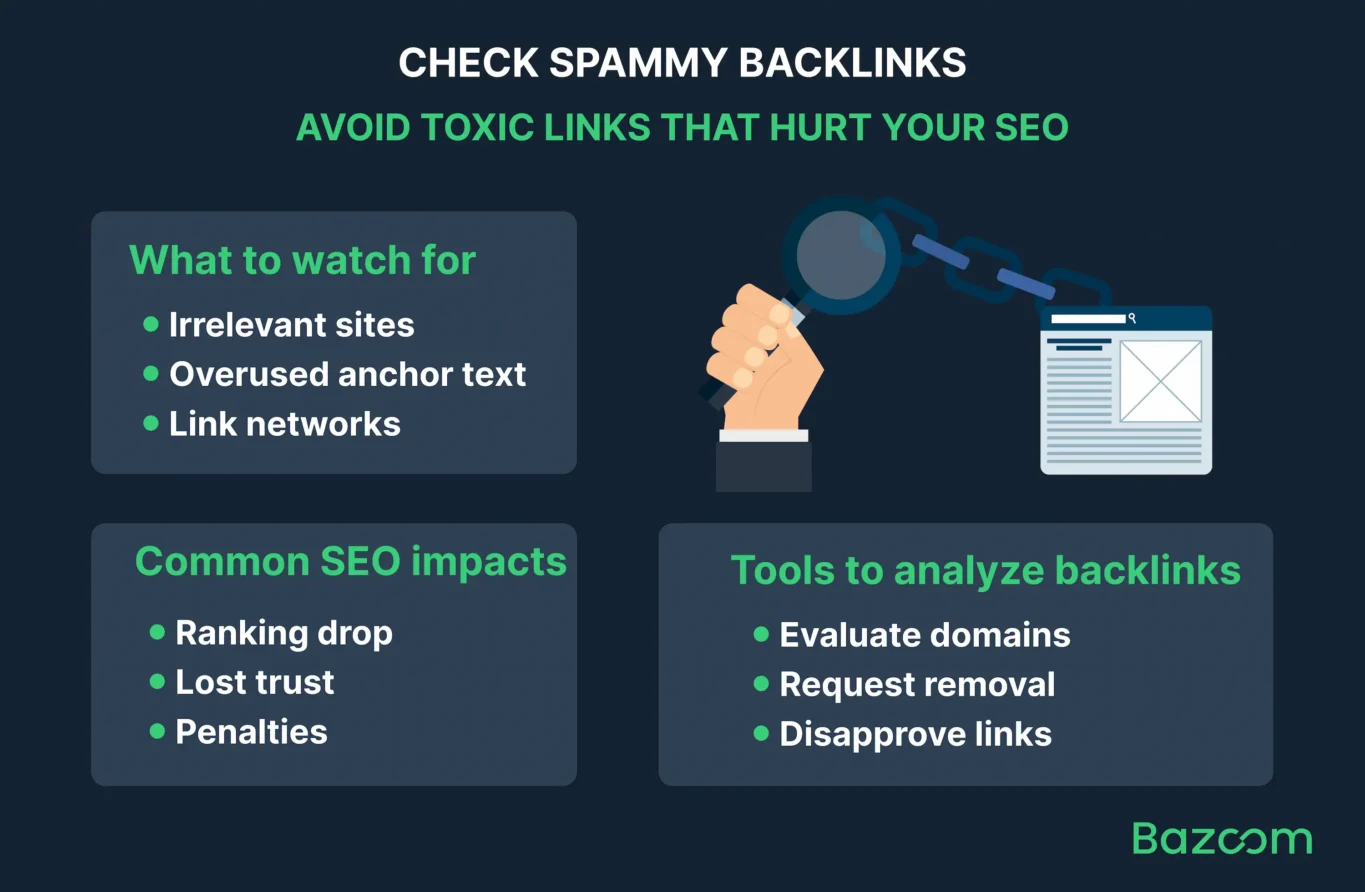
Some clear signals to look out for include links from irrelevant sites and unnatural anchor text repetition. PBNs (private blog networks) can also be an indicator. A PBN is a network of websites created solely to manipulate search rankings by linking to each other or to a target site, often with low-quality content and little authority. Luckily there are toxic link checkers and tools like Google Search Console that can help you review and manage your website’s external links.
Some toxic backlinks can look like legitimate inbound links at first, such as a “resources” article that includes your site but is filled with unrelated outbound links. You might also see keyword-stuffed backlink anchor text placed in articles that barely relate to your industry. These inbound links appear normal on the surface but are designed to manipulate search rankings.
The earlier you detect toxic backlinks, the better. The longer spam backlinks point to your webpage, the more likely search engines are to interpret them as intentional manipulation. Catching them earlier means you can remove harmful links before they damage your credibility and SEO efforts. This will help you to prevent issues like a Google penalty.
Bazoom’s reporting tools make it even easier to spot toxic backlinks by highlighting key metrics like domain authority, backlink data, traffic, and relevance before a link ever goes live. With clear, audit-ready reports and backlink analysis, you can quickly identify suspicious sources and avoid links that may harm your SEO metrics.
What’s the real damage of spam backlinks?
Toxic links can quietly erode your website’s SEO health, often before you even realize something is wrong. When search engines detect toxic backlinks pointing to your site, they may interpret them as attempts to manipulate rankings. This can lead to a noticeable drop in search visibility, a loss of domain credibility, and in more serious cases, Google penalties that take months to recover from.
The impact can snowball quickly. Imagine your webpage suddenly receives a handful of spam backlinks from irrelevant directories or automated blogs. On their own, they may seem harmless, but once search engines pick up the pattern, those links can trigger further scrutiny. As trust signals weaken, your website’s SEO performance starts to slip, organic traffic drops and competitors gain an edge. All because of a few unchecked external backlinks.
If you discover harmful links in your audit, create a recovery plan. Alongside cleaning up toxic backlinks, use Bazoom to secure trustworthy, niche-relevant backlinks that restore your site’s authority.
There are some cases where these tactics are part of a negative SEO attack, where bad actors deliberately point harmful links at a competitor’s site to damage its reputation. These attacks rely on volume and low-quality link schemes to make a site look manipulative, even if the owner had nothing to do with it.
To avoid these situations, it’s important to run regular backlink audits. Bazoom can make it easy to review link quality, detect suspicious domains early and protect your site from long-term damage.
Essential tools and methods for analyzing backlinks
The good news is you’re not alone. There are so many easy and effective ways to analyze unnatural backlinks to find out if they are toxic backlinks for SEO. Using a mix of major backlink checkers and tools like Google Search Console for first-party link data and third-party services like Ahrefs, Semrush or Moz for deeper metrics. You can start by exporting your full backlink list from Google Search Console and one of the previously mentioned third-party tools, so you can compare sources.
A step-by-step guide:
- Aggregate and sort: Combine exports and sort by referring domain and date to spot recent spikes or many links from the same site.
- Filter low-quality signals: Flag domains with very low authority, high spam scores, minimal estimated traffic or irrelevant content.
- Check anchor text: Look for exact-match or repeated keyword anchors and sudden changes in anchor-text distribution.
- Investigate anomalies: Open a sample of flagged pages. If the content is thin, unrelated or stuffed with outbound links, mark it as risky.
- Take action: Contact webmasters to request removal, then prepare a disavow file for Google if removals fail. Log every step for auditing.
With the right tools and methods for analyzing backlinks in place, it becomes much easier to separate healthy references from toxic backlinks issues before they escalate. After identifying risky backlinks, focus on rebuilding your profile. Bazoom makes it easy to acquire high-quality backlinks from reputable sources, helping you offset damage and strengthen your ranking signals.
“The smartest way to monitor backlinks is to mix automated alerts with manual checks. Alerts can catch spikes, new links or rising spam scores fast, but a quick manual review makes sure those links actually make sense. Together, they help you avoid false alarms and keep your site safe from penalties.”
– Tamara Novitović, Head of SEO at Bazoom Group
Evaluate domain authority and anchor text relevance
A good place to start when looking for toxic links is to evaluate the credibility of the linking domain. Look out for incoming links from low-quality, spammy, or irrelevant websites that could harm your site’s SEO performance. Indicators like low domain authority (DA/DR), minimal organic traffic, irrelevant content, or a history of spam backlinks suggest a domain may be risky.
Relevance is just as important as authority is in Google’s eyes. Even a link from a high-authority site can feel manipulative if it’s unrelated to your niche. Don’t just evaluate the domain metrics, but also whether the linking page truly aligns with your content.
Another important signal is anchor text. Over-optimized or exact-match anchor text (especially repeated across many links) can signal artificial link building. A quick way to check is to ask yourself:
- Does the anchor text read naturally in context rather than looking forced?
- Does the surrounding content logically relate to your site’s topic or niche?
- Are anchors varied rather than identical keyword-heavy phrases?
If a link fails these checks, it’s likely risky and should be flagged for removal.
How to contact webmasters for link removal
If you find spammy backlinks pointing to your site, contacting the linking webmaster is the first step in protecting your webpage. A clear approach can increase the chances of successful removal.
Follow these steps:
Step 1: Contact website owners
Check the website’s “Contact” or “About” pages for email addresses. If no direct contact exists, try a WHOIS lookup or professional social profiles associated with the domain.
Step 2: Write a concise outreach message
Your email should be polite and very specific; this can help to prevent back-and-forth. Include the exact URL of the spam backlink, explain that it may negatively impact your site’s webpage and request removal. Example template: ‘Hello (Name), I noticed a link to our site on (URL). It appears to be outdated or irrelevant and may affect our SEO. Could you please remove or update the link? Thank you for your help.”
Step 3: Track responses and follow up
Keep a log of outreach attempts and replies. If you don’t receive a response within 1-2 weeks, a polite follow-up often improves success rates. Consistent follow-up signals professionalism and increases the likelihood of removal.
Once you’ve removed or disavowed harmful links, start replacing them with high-value backlinks. Bazoom helps you find authoritative publishers and secure links that positively impact your SEO. They can simplify this process by providing templates for outreach and tracking your communications, making it easier to manage multiple requests while safeguarding your site from the harmful effects of spammy links.
Creating and submitting a disavow file the right way
Google’s disavow tool is designed to tell search engines to ignore certain links pointing to your site. This is an effective tool, but it’s important to use it wisely as improper use can harm your rankings and website’s visibility. You should only use the tool on toxic backlinks in your SEO strategy that can’t be removed manually. You should also be cautious and never disavow links from legitimate, high-quality sites.
Steps to prepare and submit your disavow file:
- Export your backlink list: Collect links from Google Search Console and third-party tools.
- Identify toxic backlinks: Flag low-quality, irrelevant or spammy domains that you can’t remove manually.
- Format your file: Create a plain text file (.txt), listing one URL or domain per line.
- Submit via Search Console: Go to the Google Disavow Links tool, select your property and upload the file.
- Document your actions: Keep a record of disavowed links for future reference.
Make sure to periodically review and disavow files to catch new toxic links and remove links that may have been cleaned or removed. Bazoom can simplify this process by helping you organize your disavow file, track changes and maintain a clear audit trail, ensuring your site stays protected from harmful, toxic links and their potential SEO consequences.
Discover smart, ethical strategies for building better backlinks
Building a strong backlink profile doesn’t have to rely on risky shortcuts. Focusing on white hat strategies ensures your site earns links that are both sustainable and safe from search penalties. Proven tactics include guest posting on reputable blogs, reaching out to industry-relevant websites with valuable content, and cultivating relationships with influencers or authoritative sites in your niche.

Editorial standards and relevance are important. Every link you earn should make sense contextually; it should come from content related to your topic and provide genuine value to readers. This approach naturally reduces the risk of spammy backlinks or accidentally acquiring a toxic backlink, which could harm your rankings or credibility.
Avoid quick fixes like purchasing bulk links or engaging in link-exchange schemes. While they may appear to provide fast results, these spam backlinks often backfire and can lead to long-term SEO penalties.
By prioritizing quality over quantity, you build a resilient, authoritative link profile. Organic links earned through careful outreach and thoughtful content creation not only improve search engine visibility but also strengthen your brand’s reputation. Over time, these ethical strategies provide a safer and more sustainable foundation for SEO success.
If you’re ready to build a safer, stronger backlink profile, explore Bazoom’s marketplace to find relevant, authoritative sites where you can earn quality backlinks.
Learn how to set up continuous backlink monitoring
Maintaining a healthy backlink profile requires more than a one-time audit. Establish a routine schedule for checking for spammy backlinks, whether monthly or quarterly, to stay on top of links that are toxic before they impact your SEO metrics.
Automated monitoring tools can simplify this process. Set up alerts to notify you of unusual spikes in new links or sudden drops in referring domains. These signals often indicate spam activity or potential negative SEO campaigns. Pair automated alerts with periodic manual checks to ensure that flagged links are genuinely risky and not false positives.
Dynamic reviews help you maintain long-term SEO health. With consistent backlink analysis, you can identify patterns of spammy backlinks or potential toxic links early, allowing for swift action such as outreach, removal requests or disavowal.
Bazoom can make continuous monitoring easy with intuitive dashboards, real-time alerts and organized reports. With Bazoom, you can track new backlinks, spot suspicious activity quickly and maintain a clear audit trail. This gives you peace of mind that your site is protected against harmful links while keeping your SEO performance strong.
Our recommended action steps for healthy backlinks
Maintaining a strong backlink profile requires a proactive, step-by-step approach. Start by checking spammy backlinks regularly to identify any low-quality or irrelevant links that could harm your SEO. Use reliable tools to compile a comprehensive list of all referring domains and highlight potential risks.
Next, carefully analyze each link for authority, relevance and anchor text naturalness. Flag any links that appear manipulative, over-optimized or coming from suspicious domains. This stage ensures you separate genuine, valuable backlinks from harmful ones.
Once identified, take action. Reach out to webmasters to request removal of spammy backlinks, and for links that cannot be removed manually, prepare and submit a disavow file to Google. Bazoom can simplify this process, providing templates, tracking and organized reporting to streamline management.
Finally, focus on sustainable, white hat link building strategies like guest posting, content outreach and relationship-building to earn high-quality, relevant backlinks that strengthen your site’s authority.
Regular audits and ongoing management are essential. By making backlink health a continuous priority and leveraging solutions like Bazoom for monitoring, reporting and outreach, you can take full control of your SEO performance and protect your site from the risk associated with toxic links.
Bazoom can make each step of the way easier, from identifying suspicious links to tracking outreach efforts and monitoring new backlinks, so you can stay ahead of potential threats. Backlink management is not a one-time task; it requires ongoing vigilance, periodic reviews and proactive practices to ensure your site remains authoritative and visible in search engine results.
Take control of your backlink strategy today. Use trusted tools to monitor backlink health, and rely on Bazoom to consistently build high-quality, long-term backlinks that support sustainable SEO success.