Backlink management: A fundamental part of your SEO strategy

Jump to section [Open]
If search engines can only judge what they see, what are your inbound links and backlinks really saying about your site? Backlink management shapes that signal. When you stay on top of the links pointing your way, you catch weak or spammy links early. Plus, you can strengthen the ones that help you and protect your visibility. This steady routine keeps your authority growing instead of drifting as new links appear and older external links lose value.
Bazoom makes this easier. Our link management tool helps you manage your backlinks and monitor backlinks in one clear dashboard. This gives you a healthier link profile without slowing down your SEO efforts. Take the first step toward organized link management with us here at Bazoom.
The impact of systematic backlink oversight
Your SEO results change the moment you treat backlink management as a routine instead of a guess. That change starts with keeping every link organized, including inbound links, external links, and websites linking to your most important pages. This is something that we here at Bazoom can help you with from day one. When you can see which links support your authority and which ones quietly weaken it, you stop reacting to rankings. Instead, you become proactive and start shaping them through effective backlink management.
“Most SEO issues don’t come from what you can see; they come from the links you haven’t checked in months. A structured review rhythm fixes that faster than any quick win ever will.”
– Tamara Novitović, Head of SEO at Bazoom Group
This kind of structure forms the backbone of managing your backlinks with confidence, and it’s why our platform favors clarity over guesswork.
Systematic oversight also gives search engines a pattern they can trust. When you review links regularly and refine anchor text, you show Google a steady signal of relevance. If you add strengthening high-value placements and removing harmful links, you elevate even more. This matters a lot when managing dofollow links, nofollow links, and everything in between. That stability often separates sites that grow consistently from those that drift up and down the search engine results pages.
Backlink management works best when you understand how to manage backlinks in a way that reinforces trust, relevance, and clear link quality. You also avoid the blind spots that appear when backlink reviews are done once in a while instead of on a schedule. Broken links, spammy domains, and sudden drops slip in quietly. But a weekly review catches them before they build into something costly.
You can recover lost backlinks and visibility simply by identifying a cluster of toxic links and replacing them with stronger and more relevant backlinks. It is a simple link building process adjustment that delivers a measurable improvement. Backlinks management is at its strongest when it becomes a habit rather than a rescue mission.
See how structured oversight works in practice by trying Bazoom’s backlink manager for yourself.
What are backlinks and what is their role in SEO?
Backlinks are simply external links pointing toward your site, and search engines pay close attention to who is doing the pointing. When a respected site links to you, it tells Google your content is worth trusting. When the link comes from a weak or irrelevant page, it can send the opposite message. A single high-quality backlink can often help your visibility more than a long list of low-quality links. Especially when Google evaluates your website’s backlink profile for authority and relevance.
You notice the importance of backlinks most clearly when you understand how to judge each one. At Bazoom, we give you straightforward guidance on backlink types, including dofollow and nofollow links, and how to read their value. This means you’re not left guessing which links support your authority.
This approach also helps you see how backlinks pointing to older content still influence your long-term visibility. Quality always matters more than sheer quantity, and search engines respond better to relevant backlinks that sit naturally within your niche.
The role of backlinks in search engine optimization becomes even clearer over time. Sites that earn steady, authoritative links often grow in a way Google can interpret. While sites that rely on scattered or weak links rarely build lasting strength. A reliable backlinks manager helps you stay focused on what actually moves your rankings instead of chasing more links for the sake of volume.
How backlinks influence search engine rankings
Backlinks influence your rankings because search engines treat them as evidence of trust and relevance. When a credible site links to you, it signals that your content deserves attention. When a weak or unrelated linking site points your way, that signal becomes unclear. This is why authority, relevance, and context matter. They matter in how your pages are interpreted by search engine algorithms.
You see this most evidently in factors like domain authority and anchor text. A link from a respected source with a clear and relevant anchor text can help your visibility. While a low-quality link can have the opposite effect. With our link tracking tools, you can see how to manage your backlinks in real time and respond to problems before they affect your rankings. It is one of the key backlink management benefits that comes from using structured backlink management tools.
When those links are relevant, they pass stronger link juice, which can raise the overall strength of your backlink profile.
A simple example shows how much this matters: one client saw steady ranking gains after replacing a handful of weak links with a few relevant and well-placed ones. The number of backlinks stayed similar, but the improvement in link quality and link equity helped their visibility rise quickly.
The lesson is that continual monitoring protects you from relying on signals that no longer help your site grow.
The need to manage links for a healthy profile
A healthy backlink profile depends on steady upkeep rather than collecting as many links as possible. Strong search engine optimization comes from knowing how to manage backlinks in a way that protects your authority over time. That means looking at your existing link profile and link building efforts often enough to see which ones still help you. This will also allow you to see which ones may be holding you back.
Some links break without warning, and some come from pages that no longer match your content. Others simply lose value over time as linking sites change direction. With our backlink audit tools, you can spot these changes quickly. You can step in before they lead to search engine penalties or limit your long-term visibility. Routine reviews also make backlink management easier because you stay ahead of problems instead of cleaning them up later.
A healthy backlink profile grows when you focus on relevance, trust, and regular care. Monitoring link quality, watching out for harmful links, and keeping anchor text distribution natural all make it easier to maintain a healthy link profile. Steady audits give you the best chance of staying competitive while avoiding search engine penalties caused by outdated or toxic links.
Learn how to identify and acquire high-quality links
High-quality backlinks come from sites that add genuine value to your content rather than any page willing to link to you. The strongest results usually come from outreach rooted in relevance and authority. Whether you are guest posting on trusted blogs, exploring niche collaborations, or using competitor backlink analysis to spot real openings. When these links sit on pages with steady organic traffic, they often turn into lasting authority links. These strengthen your inbound link profile.
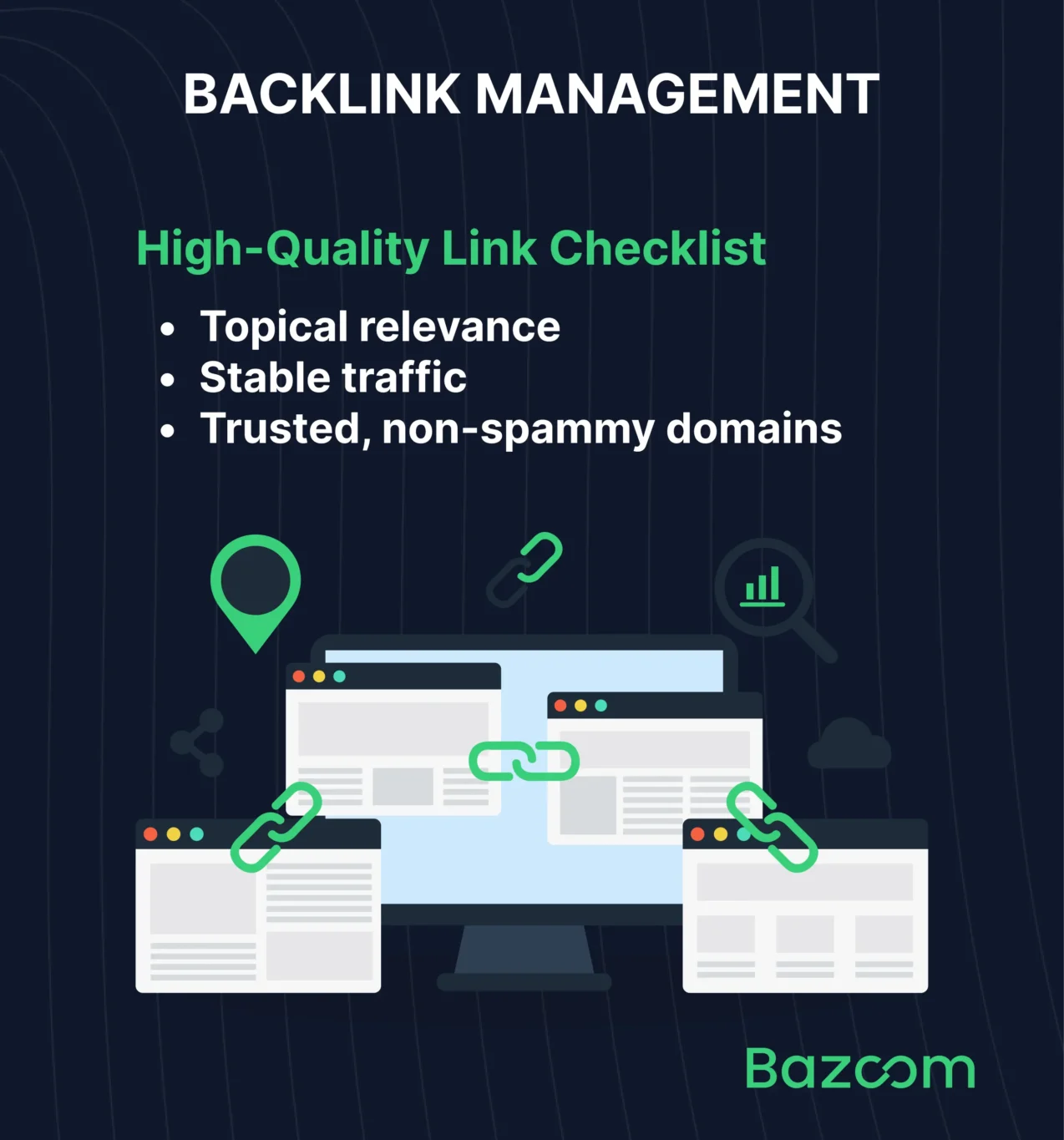
A simple checklist helps keep your process consistent.
- Look for sites with a clear topical match
- Check whether the linking page has stable traffic
- Avoid low-quality links from spammy sites
These reviews reveal broken links on reputable pages where you can secure updated placements.
Evaluating targets takes more than checking metrics. A smaller site with the right readers can deliver more relevant backlinks than an unrelated domain with high stats. Bazoom helps with this by giving you the clarity you need to judge quality. Its backlink manager highlights partners that match your goals instead of leaving you to guess.
You can also secure links through real conversations instead of using link exchange or quick tactics. When your link building strategies match your brand, each placement supports steady long-term growth and keeps your building links efforts aligned.
Explore methods to monitor existing links
Monitoring your existing backlinks keeps your SEO performance steady because you see changes the moment they happen instead of reacting after rankings move. A regular check shows whether links still exist and still point to the right pages. It also shows if the link from sites supports your content. Understanding how to manage your backlinks at this stage is essential, especially when negative patterns can slip in without warning.
Dashboards and monitoring platforms make this much easier. Bazoom’s backlink dashboard gives you a clear view of new links, lost links, and shifts in link quality. This allows you to track patterns without jumping between tools. It works as a practical backlink manager and acts as part of your wider link building management tool setup. This level of backlinks management monitoring helps you respond faster when a site updates anchor text or a domain drops in authority. It also helps you see if a link disappears.
“Our easy-to-navigate dashboard will allow you to find all the information you need. This will allow you to track all your operations without needing to jump from tool to tool.”
– Nikolaj Østergaard, Co-Founder at Bazoom Group
A simple monitoring rhythm also shows you which backlinks stay strong over time and which ones decline. This makes future planning clearer, while reducing the risk of negative SEO impacts.
Analyze the quality and relevance of each link
Evaluating the quality of each backlink is central to analyzing backlinks and understanding which links genuinely support your visibility and which ones may be holding you back. Domain authority is only a starting point. Relevance often carries more weight because search engines look for clear topical connections between your content and the linking page. A link from a credible, subject-aligned site reinforces trust. While a link from an off-topic or low-effort domain can send mixed signals.
Anchor text gives context, so it should match the topic naturally without feeling forced or over-optimized. Sudden changes in anchor patterns can also indicate risk. Traffic and engagement on the linking site matter too, because stable organic activity usually reflects real authority.
Toxic links are easy to spot once you know the signs. Link farms, spun-content networks, and sites publishing unrelated posts at scale rarely help long-term performance. These are worth removing or disavowing as part of a broader backlink management strategy. Bazoom’s filters make this process easier by highlighting risk levels, authority signals, and relevance. This means you can focus on the links that move your rankings in the right direction.
Discover tools for backlink analysis and management
Effective backlink analysis starts with tools that show changes the moment they happen. Free platforms give you a strong baseline, and paid SEO tools build on that with deeper insight.
- Google Search Console: Tracks new links and lost links and helps you see how search engines read your backlink profile
- Google Analytics: Shows referral traffic and organic traffic so you can judge real link quality
- Ahrefs: Provides fast authority checks and wide coverage of links pointing to your site
- Moz: Highlights long-term domain authority patterns
- Semrush: Adds competitive insight to strengthen your link profile
Where many teams struggle is turning data into action. Bazoom solves this with a clear backlink manager that gives you simple filters and real-time alerts. Plus, we give you quick ways to spot harmful links or toxic links before they trigger search engine penalties. It also shows which websites linking to your pages need attention.
Bazoom works as a practical link building tool because it turns heavy reports into steps you can follow. Many teams use it as the best backlink manager when they want speed and clarity. With backlink management software and backlink tracking software in one place, Bazoom delivers the actionable insight that other analysis software tools often miss.
Our step-by-step guide to backlink management
Backlink management feels far easier when you follow a simple set of steps that show you what to do next. Bazoom’s dashboard is built for clarity, so you can learn how to manage backlinks without getting lost in complex reports. It also gives you the clean structure you need for practical link building management tool usage.
- Import your backlinks
Start by loading your backlinks into Bazoom. You get an instant overview of new links, lost backlinks, and existing links in one place. Along with a real-time snapshot of your backlink health.
- Sort and filter your data
Group links by domain authority, relevance, link quality, risk level, or status. A backlink manager makes this easier because you can see patterns immediately instead of scrolling through long tables.
- Identify issues quickly
Flag links that look suspicious or domains that have dropped in quality. Catching these problems early protects your rankings before they slip.
- Set up alerts
Turn on notifications so you hear about changes automatically. When a link disappears, anchor text shifts, or a site’s authority drops, Bazoom alerts you before it affects your visibility.
- Build a routine you can follow
This workflow helps anyone new to link building build confidence fast. Whether you’re running link building campaigns or refining an ongoing link building operation, structure always pays off. Over time, this approach keeps your backlink profile organized and healthy.
Strategies for cultivating relationships with link partners
Strong link building relationships grow when you treat partners as long-term collaborators rather than one-off opportunities. When someone understands your work and audience, the links they offer usually fit better, last longer, and support steadier growth. This is why genuine conversations often outperform quick outreach blasts.
Good link partner outreach starts with simple and personal steps. You could comment on relevant posts or reply to industry updates. You could also send a short message that shows you know their work builds trust faster than any template. Bazoom’s backlinks manager helps keep this organized by showing who you’ve contacted and what was discussed. Plus, it shows you which sites may need a follow-up.
Maintaining partnerships matters just as much as starting them. If you only reach out once, the relationship fades. A quick check-in, sharing an article, or acknowledging something they’ve published keeps the connection alive and natural. Over time, these touches create a small network of people who actively keep you in mind for strong placements.
Bazoom supports this long-term approach by giving you one place to track notes, monitor progress, and stay consistent. When you nurture relationships instead of chasing shortcuts, your backlink profile becomes stronger, steadier, and far easier to grow.
Common backlink management pitfalls
Most backlink management mistakes come from moving too fast without thinking about the long-term impact. Chasing quantity over quality is one of the most common issues in search engine optimization. A long list of weak or off-topic links may look like progress, but low-quality links often send mixed signals to search engines and do little to support your visibility. Choosing partners who match your content helps you avoid these link building missteps.
Skipping regular audits causes just as many problems. When you put off routine checks, you miss broken links, redirected pages, and domains that have declined in quality. Many backlinks manager errors come from relying on old data or assuming a link still helps when it no longer does. Backlink monitoring prevents this by giving you a clear, up-to-date view of your website’s backlink health.
Risky tactics can be just as damaging. Buying links or joining schemes often leads to penalties that take time to fix. One site we worked with saw its rankings fall after picking up paid links from unrelated blogs. Removing those links and replacing them with relevant backlinks helped the site recover and avoid search engine penalties moving forward.
Steering clear of these backlink management mistakes keeps your profile steady and prevents harmful links from dragging you down. It also supports cleaner long-term growth across search engine results pages.
Tips for long-term health and audits
A strong backlink profile is built through regular monitoring that keeps small issues from turning into bigger setbacks. Short reviews each week or month show you how your links are changing and whether they still support your goals. Using Bazoom makes this easier because the platform displays new links and lost links the moment they appear. You also see how backlinks drive referral traffic, giving you a fuller view of performance beyond rankings alone. This steady rhythm makes maintaining backlinks far more manageable as your site grows.
Real long-term progress comes from routines rather than one-off fixes. Many teams follow a short checklist instead of a long technical audit, especially when carrying out backlink audits:
- Look at the links you gained and lost since your last review
- Check whether linking sites still carry the same level of trust
- Read through anchor text to make sure it still matches your topic
- Update older pages that still pull visits but feel outdated
Fresh content helps your profile stay active and often brings in natural links. Updating older pieces or exploring related topics uncovers new opportunities and keeps your link building strategy updates aligned with your overall SEO goals.
Bazoom’s alerts cut down the work by pointing you straight to what changed, which saves time and keeps you ahead of problems. When these habits become part of your ongoing practice, your backlink profile grows in a steady, manageable way as your site develops.
If you’re ready to manage backlinks with less effort and more clarity, let Bazoom guide you through every step.