The importance of a backlink dashboard
Jump to section [Open]
What if the health of your entire SEO strategy depended on data you are not tracking? Most SEO teams only realize how much they are missing when a ranking suddenly drops. This is why it is essential to monitor backlinks. Backlinks carry huge weight in how search engines judge authority and relevance, particularly from linking domains. But keeping track of them by hand becomes unmanageable far sooner than most people expect.
New links appear quietly, old ones disappear without warning, and the occasional toxic link slips through the cracks. When you only catch backlink changes weeks later, you are already on the back foot. With a backlink dashboard laying out each new, lost, and risky link in one view, you can act before issues build up instead of fighting to regain lost ground later. It helps you protect valuable authority signals and focus on the links that matter.
Understanding backlink dashboards
A backlink dashboard gives you a clear view of the links that influence your authority and reveals changes you would almost certainly miss on your own. It becomes essential the moment your site grows past the point where manual checks can keep up, especially when monitoring your growing domain authority.
 Here at Bazoom, we help teams build dashboards that stay organized as their backlink planning develops. This gives you a more reliable way to manage a growing link profile across different markets and content types. When your data sits in one structured place, you no longer need to move between backlinks or keep updating scattered spreadsheets.
“Teams fall behind when backlink data lives across five or six tools. A dashboard brings everything into one place, which saves hours every week. This is massively helpful.”
– Jonathan X. Valtersson, SEO Strategist at Bazoom Group
Instead, you work with a tool for backlink management that gives you a straightforward look at what is happening in your link profile. Some links arrive from places you expected, others fall away without a clear reason, and occasionally you will spot something that feels out of place.
Having everything pulled into one view removes the guesswork and stops you from jumping between different sources trying to understand the full picture.
If you want help setting up a dashboard that fits your workflow, reach out, and we’ll guide you through the process.
A dashboard for backlinks helps you notice the changes that actually matter. Plenty of links appear and fade without affecting performance at all. But, real-time tracking makes it easier to catch spammy links and signals that require attention.
Consistently monitoring your backlinks leads to long-term benefits, such as:
- Clearer insight into the links that strengthen or weaken your authority
- Faster identification of harmful or low-value links
- Less manual workload as your link profile grows
- More strategic decisions based on reliable, real-time data
With that kind of overview, deciding where to focus becomes far simpler. A reliable dashboard keeps your work steady as your link profile expands. It also helps develop patterns that are harder to track manually. It reduces the time spent checking platforms by hand and helps you understand why visibility changes when rankings rise or dip.
Definition and importance of a backlink checker
A backlink dashboard gives you one place to check the links that point to your site. It gathers the essentials, such as fresh link activity and the general strength of the domains sending those links. It also looks at citation flow and the backlink anchor text they used.
Instead of stitching information together yourself, everything you rely on is pulled into one view. This matters because backlinks still influence how much trust search engines place in your site. When you can spot a new link, notice one that has dropped, or see early signs of something risky, you have a far greater chance of protecting your authority. You can do this well before it starts to dip.
Functionality and benefits
The core job of a backlink dashboard is to gather your link data so you can work through it without wasting time. You can filter your links in whatever way makes sense, including a quick check on the strength of the sites linking to you.
Sometimes you might want to gauge whether a linking domain is authoritative, or you may simply be checking whether a link still exists. Most dashboards also send quick alerts when something changes, so you find out early rather than after the impact appears.
That alone removes many of the small jobs that slow people down. When the information is already laid out, it becomes easier to decide what deserves attention. It also allows you to understand when to adjust your link building work. If a valuable link disappears, the dashboard shows it immediately, giving you a chance to step in before the loss affects your visibility.
Key features of an effective backlink dashboard
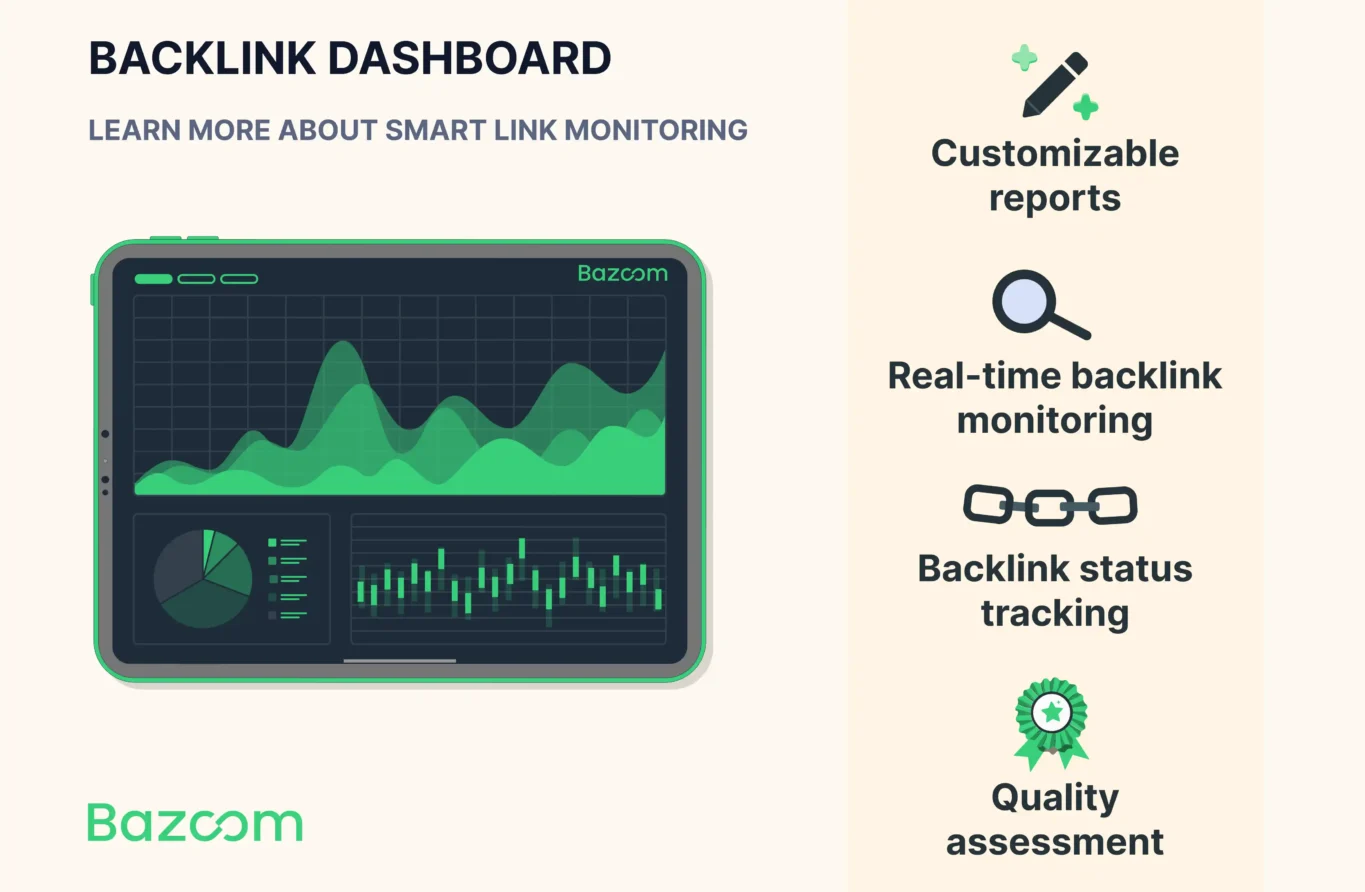
A strong backlink dashboard gives you the tools to assess backlink health quickly and work with your data in a way that supports day-to-day decisions. You get sharper visualization, better filtering, and a tracking tool for backlinks that highlights patterns you would otherwise miss.
Good analysis software for backlink monitoring also connects smoothly with other SEO setups, and many dashboards can expand through APIs or add-ons when your needs grow. The goal is to give you a backlink manager solution that keeps link analysis simple. Instead of something you piece together manually. To make that possible, a dashboard needs a few core features, and the sections below break down the ones that matter most.
Real-time backlink monitoring
Real-time backlink monitoring lets you catch important link changes the moment they appear. Rankings can shift long before you notice anything manually. So, a dashboard with a dependable backlink monitor or SEO monitor for backlinks gives you a faster sense of what is strengthening your visibility. It also allows you to see what is weakening your visibility.
With reliable tools for backlink monitoring, you can see valuable new links as they arrive and spot harmful or suspicious ones before they create problems. That speed keeps you in control. When a trusted site links to you, you can build on the momentum. If something looks off, monitoring backlinks makes it easier to review or disavow before damage sets in.
Real-time checking keeps your strategy proactive instead of reactive and helps protect your authority when your link profile shifts suddenly. If you want help choosing a dashboard that monitors link changes in real time, we can guide you toward the setups that offer the strongest performance.
Backlink quality assessment
Checking the quality of your backlinks matters as much as counting them. Most people start by looking at the strength and relevance of the site linking to you. Since a link from a trusted domain usually carries more weight than one from a weaker competitor, this makes sense. Anchor text also plays a role because it shows whether the link fits naturally within the content. Spam scores and page-level signals help you spot links that may cause problems later.
A quick review of your backlink profile often reveals both risks and easy wins. Monitoring tools for toxic backlinks and software to manage spam links make it easier to identify sites that could hurt your visibility. Some teams even use a backlink alarm system to catch issues early. Strong links from relevant domains usually build authority faster than simply adding more low-quality backlinks.
Backlink status tracking
Knowing whether your backlinks are new, lost, or broken is one of the most useful parts of any dashboard. You can monitor backlink changes as they happen instead of waiting for a monthly audit. This helps you keep your backlink profile healthy. Links disappear for simple reasons. A page gets updated, an article is removed, or a technical issue breaks a URL without anyone noticing.

With a backlink monitoring tool running on something close to an SEO backlink monitoring sync, you see those movements straight away. It becomes even more useful when you use keyword tracking plus backlinks, because you can connect lost links with dips in visibility. Restoring a strong link can make a measurable difference. If a valuable page removes your link during a redesign, reaching out and getting it reinstated often restores part of the authority you lost. That is where keyword tracking & link building synergy becomes clear.
Customizable reporting and analytics
Customizable reporting matters because different people need different levels of detail. Executives want a broad overview of how authority is shifting, while SEO specialists often need to dig into referring domains, anchor patterns, and link velocity. Marketers usually want summaries that show whether recent campaigns attracted the right links.
A good dashboard lets each team filter and shape the data in a way that fits their role. When you can pull reports that highlight only the information you need, performance becomes much easier to evaluate. This includes insights from third-party tools. It also turns backlink tracking into something more actionable because everyone sees the same information in a format they can use.
How to integrate backlink dashboards with SEO tools
Linking your backlink dashboard with your wider SEO stack helps you understand how your links behave and what they contribute. When your dashboard connects to Google Analytics, you can instantly see how many links contribute to your website’s backlink profile. This includes keyword trackers or site audit platforms. All of this allows you to understand your overall performance.
These integrations help with content planning because you can match backlinks to the pages that attract real traffic or conversions. This kind of joint reporting often reveals trends you would miss if the data sat in separate tools. If a piece of content earns strong links but users leave quickly, the page needs refining. If another page earns links and drives consistent sessions, it becomes a model worth repeating.
“Dashboards only show their full value when they connect with the other tools you use every day. Seeing link data alongside traffic insights helps you understand which backlinks actually move the needle.”
– Tamara Novitović, Head of SEO at Bazoom Group
Outreach becomes simpler as well. When your dashboard shows how link changes align with keyword movements, you can see which placements genuinely influence rankings. Site audit integrations support this by revealing technical issues that weaken strong links.
Once everything works together, link building stops feeling like an isolated task. You plan content with better data, adjust outreach where the results are visible, and refine your strategy without guessing.
We can help you connect your backlink dashboard with your other SEO tools and build an integrated setup that works smoothly from day one.
Enhancing data analysis
You gain a much better sense of what your links are doing when you compare them with traffic and engagement data. Once you can monitor your backlinks in the same place you analyze conversions, it becomes more apparent which links attract users who stay, read, or purchase.
Some links look strong, but do nothing when you check user behavior. Using tools for backlink monitoring and analysis this way also helps with campaign-level backlink tracking. You start spotting signals you would have missed before. For example, certain publishers sending visitors who convert far more often. This makes it easier to refine your link building approach based on real outcomes.
Comprehensive SEO management
A backlink dashboard is far more powerful when it connects with your wider SEO toolkit. Once your links sit alongside technical audits and on-page checks, it’s much easier to see how everything fits together. This includes link distribution and content performance. You are not switching between tools to guess why a page dropped or which issue needs attention first. This kind of setup keeps small problems from slipping through.
A technical issue that weakens a strong link, an on-page change that affects a keyword, or a new link that should guide your future content all appear more quickly. This is only possible when the data lives in one place. Holistic management keeps your decisions steady because you can see how each part of your SEO supports the others.
Choosing the right backlink dashboard for your needs
Choosing the right backlink dashboard starts with understanding how you already work. Before comparing features across SaaS companies, consider how each option can enhance your link building campaigns. Some people just need a place to check new and lost links, while others depend on deeper analytics, automation, or API access to guide their work. Pricing, ease of use, and scalability tend to be the factors that influence the final choice.
Start by testing how each platform handles simple tasks such as checking referring domains or running a quick audit. If the interface slows you down or hides essential details, it might not hold up long-term. Larger sites or agencies may need dashboards that support team access, stronger reporting, and smooth integrations with analytics and keyword tools. Smaller teams can often work comfortably with lighter dashboards that focus on the essentials.
Best fits by user type:
- Solo SEOs and freelancers: affordable, straightforward, enough features for daily checks
- Growing teams or agencies: shared dashboards, reliable reporting, room to expand
- Enterprise setups: API access, automation, deeper technical insights
Once you align your needs with the right category, choosing feels much simpler, and the dashboard you select becomes a genuine help rather than another tool to manage. Reach out, and our team will help you choose a dashboard that fits your workflow and goals.
Selection criteria
Selecting a backlink dashboard begins with usability. If the interface slows you down, no advanced feature will compensate for the lost time. A strong platform should let you move smoothly through link data. Whether you are reviewing a single URL or scanning backlink health tracking insights. Report customization also matters when different teams need their own views.
Key factors to evaluate:
- Interface clarity and speed
- Accuracy and freshness of link data
- Reporting flexibility
- Alert options for new, lost, or risky links
- Available integrations with SEO and analytics tools
Data reliability is another essential factor. A reporting dashboard for backlinks should update often enough to reflect your link building efforts so the numbers stay accurate. Alerts also help, since early notifications prevent small issues from becoming bigger ones. Agencies and larger teams often benefit from multi-user access, shared workspaces, and deeper analytics. A reliable software for link monitoring keeps collaboration simple and ensures everyone works from the same information.
Explore our comparison of popular backlink dashboards
Finding the right backlink dashboard becomes simpler once you understand which tools suit different types of teams. At Bazoom, we assist our clients in making this decision because the right platform depends on how much data you manage. It also depends on how quickly your link profile is growing and the level of reporting you need. Some dashboards are ideal for quick daily checks, while others serve agencies that require deeper analytics and stronger integrations.
For smaller businesses or freelancers, Linkody is an easy starting point. It is low-cost and quick to set up. Plus, it handles basic checks such as new dofollow links, lost links, simple alerts, and even free backlink analysis.
The limitation is depth, so it is best suited for lighter monitoring needs. A stronger mid-range option is SE Ranking, which provides fresher data and clear keyword connections. It also offers flexible reporting. It suits growing teams or small agencies that want more insight without paying enterprise prices. Some advanced analytics sit behind higher tiers, but the platform scales well with most setups.
Larger SEO teams often rely on Ahrefs or SEMrush because they offer broad data coverage, quick updates, and powerful filters. They cost more and take time to learn, but their depth, especially in link exploration, is difficult to match. The key is selecting a dashboard that fits both your current workload and what you expect to handle in the future.
If you want a setup that stays organized as your link profile grows, we can help you choose the right dashboard and build a workflow that scales with you.