Demystifying white hat link building services
Jump to section [Open]
What if the safest way to grow your search rankings was also the most effective? White hat link building gives you exactly that: A sustainable way to improve visibility without risking penalties. Link building remains one of the few areas of SEO that still creates uncertainty.
Google keeps tightening its rules, online advice often contradicts itself, and a single mistake can trigger penalties that take months to undo. It is no surprise that many people begin by asking what white hat link building is, and whether it can help them grow without putting their site at risk. For this, they need to consult link building experts.
At its core, the white hat method is about earning placements through genuine editorial judgment. A dedicated white hat link building service matches your content to pages where it genuinely helps the reader. When white hat backlinks come from real editorial choices made by an experienced white hat link builder focused on link quality, you build trust. Additionally, you build long-term visibility rather than relying on shortcuts.
Search engines favor this approach because it mirrors how real authority is built. When trusted and authoritative websites reference your work, credibility compounds instead of disappearing with the next algorithm update.
In this guide, you will see why ethical methods outperform shortcuts and what separates the best white hat link building agency from tactics that weaken long-term visibility.
Understand the key components of white hat link building
White hat link building works because each part reinforces the next. No single step can stand alone. When you see how these pieces connect, it becomes clear why white hat SEO link building produces steady and sustainable results. These results are built on relevance and trust, ultimately leading to more traffic.
Strong content is always the first requirement for earning white hat backlinks. You cannot earn white hat backlinks unless you publish something editors genuinely want to reference. Clear guides, data-driven insights, and practical explanations give publishers a reason to link to your work. Strong content also plays a major role in outreach because editors only consider material that improves their own pages.
“Editors tend to choose sources that make their articles stronger. When your content answers real questions clearly and accurately, links grow from the value you provide instead of from requests alone.”
— Tamara Novitović, Head of SEO at Bazoom Group
Outreach works best when it prioritizes genuine relationships instead of volume. Editors respond when your message shows that you understand their audience and the purpose of their page. Thoughtful outreach turns your content into something relevant, not intrusive, which is why many teams choose white label link building solutions that focus on fit, not scale.
Relevant placements complete the process by putting your content where it naturally belongs. Search engines reward links that sit in the correct context, so an analytics article should appear beside analytics resources, not unrelated categories. When content, outreach, and relevance reinforce one another, link building white hat becomes a repeatable process that puts users first. Plus, it stays aligned with search engine guidelines. This is ultimately what leads to high-quality links that search engines trust.
Seeing these components together makes it easier to judge which parts of your content are ready for outreach and which ones still need strengthening. Turn these components into a simple checklist and review your content with this in mind. This will allow you to see exactly what needs improving before you begin outreach to earn valuable inbound links.
Busting myths: Common misconceptions about ethical link building
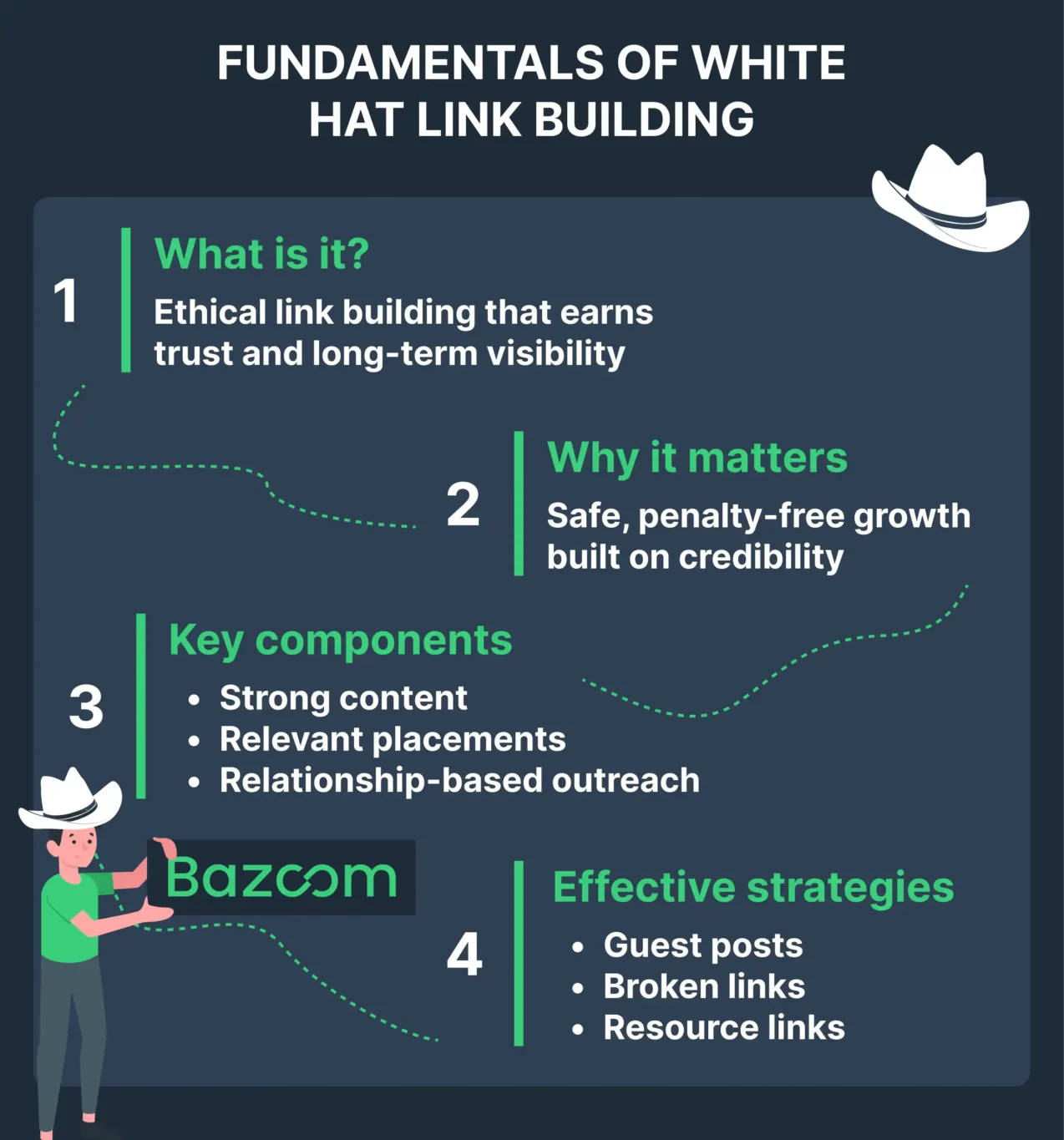
Many doubts about ethical link building come from a few persistent myths. The first is the idea that white hat backlinking is too slow. It only feels slow when compared to shortcuts. In reality, links earned from trusted sites hold their value far longer. Brands that rely on steady white hat link building techniques usually see more stable growth. Why? Because their authority is built in a predictable way. Industry studies consistently show that earned links keep their ranking impact through algorithm updates, while low-quality links lose strength quickly.
Another myth claims that black hat tactics create stronger results. They might cause brief jumps, but these gains disappear fast. Automated networks, paid link schemes, and other manipulative patterns leave footprints that Google now detects quickly. Teams that focus on ethical approaches like private label link building and white label SEO link building almost always achieve more defensible results. This is because their backlinks come from relevance and editorial judgment rather than automation or speed.
When you look at long-term outcomes, the difference is obvious. Ethical methods protect your site, build trust, and create gains that do not collapse overnight. That is why sustainable, compliant link building remains the approach that supports real long-term growth.
Explore effective white hat link building strategies
White hat link building strategies work because they create genuine editorial value. When publishers find something useful for their readers, backlinks appear as a natural by-product. The techniques below show how ethical methods improve visibility without shortcuts and why they continue to deliver reliable results.
Guest posting on authoritative sites
Guest posting is one of the most dependable white hat link building strategies because it lets you share expertise with an audience that already cares about your topic. It also places you on authoritative sites where readers actively look for trustworthy information. This means they are also more likely to link back to you with natural backlinks.
A strong process starts by identifying reputable websites in your niche and studying what their readers respond to. You want to pitch something clear, accurate, and useful rather than something written only to secure a link. When your article genuinely helps people, editors are far more open to referencing it.
A simple link building example: A data analyst writes a clear guide on reading analytics dashboards. Because it solves a real problem, editors include it naturally. A white hat link building service uses this same principle by matching your content to publications where it fits the audience. This produces durable white hat links instead of temporary gains.
Broken link building
Broken link building works because it fixes a problem for website owners. Many high-authority sites have backlinks pointing to pages that no longer exist. When you spot one of these gaps, such as dead links, you can suggest a relevant replacement from your own site. Don’t forget to understand the purpose of a missing resource.
Site owners value this because it keeps their pages accurate and useful. If a blog once linked to a campaign-tracking guide that now returns a 404, offering your updated version gives them an immediate fix. This keeps the tactic fully aligned with white hat SEO backlinks and high authority domains because everything is transparent and user-focused.
When your outreach explains why your resource fits the original intent, broken link building becomes one of the most reliable tactics any white hat link building service can use.
Resource link building
Resource link building focuses on creating content that other websites actively want to reference. It works best when your material fills a gap, answers a common question, or brings clarity where existing resources fall short. This is the kind of material that naturally earns backlinks without pushing for them.
This could be a long tutorial, a comparison guide, an expert roundup, or a curated tools list. Once you create something genuinely helpful, you can show relevant publishers exactly where it fits on their resource pages.
If you produce a detailed competitor-analysis guide, industry blogs may link to it because it strengthens their own content. This becomes another link building example editors trust, which is why this approach continues to produce durable white hat links year after year.
Together, these strategies show how ethical link building works when everything is rooted in relevance and editorial value. If you want to apply these methods more consistently, Bazoom can help you turn strong content into backlinks that support long-term authority.
Choose the right white hat link building service for your business
Choosing the right partner is one of the most important decisions you make in white hat link building. The best white label link building services act as an extension of your brand, speak to publishers on your behalf, and help you earn placements that genuinely support long-term growth. That is why link building specialists, experience, clarity, and a transparent process should always be your starting points.
A good provider is usually defined by a few key factors:
- Experience in your niche and a history of real placements
- A clear process for finding and securing opportunities
- A stable reputation supported by long-term client relationships
- A strategy shaped by your goals rather than a one-size-fits-all approach
- Transparent reporting so you can judge what each placement delivers
Case studies and samples of past placements quickly show how a team works. When you can see the type of publishers they partner with and the subjects they handle well, it becomes easier to judge whether they understand your space. It also allows you to see if they can meet the standards you expect. If their explanation of the process feels vague or they struggle to describe how they approach editors, it is usually a sign to look elsewhere.
“A reliable link building agency should feel like a partner. Look for a team that listens, understands your audience, and helps you earn links that support long-term visibility.”
— Nikolaj Østergaard, Co-Founder at Bazoom Group
Reputation also matters. A white label link building company that clients return to year after year usually does so because communication is clear and results are consistent. As you narrow your list, look at how collaborative each provider is. The best white label link building services adapt to your tone, check in regularly, and set measurable goals. Tools such as white label backlink tracking also make it easier to see each placement, when it goes live, and what it contributes.
If you want a partner who supports your goals instead of handing over a list of links, choose a team that treats link building as long-term work rather than a quick transaction. One that utilizes tools like Google Search Console.
Track your progress and measure the success of your white hat link building campaigns
Tracking the right KPIs is the only reliable way to see whether your link building is moving in the right direction. The clearest starting point is search visibility. When your rankings begin to rise and hold their position, it usually means your authority is strengthening. It also means your referring domains are becoming more relevant.
Growth in referring domains is another strong signal, as long as those domains fit your niche and come from reputable publishers. Steady growth in these areas shows that your authority is increasing in a sustainable way rather than spiking and collapsing. Traffic quality also tells you a lot and serves as an important Google ranking factor. Ethical links often send visitors who understand your topic already, which leads to better engagement and more consistent organic sessions.
A trusted white hat link building services agency should help you interpret these trends with clear updates that show what each placement contributes. It should also show where the strongest opportunities lie.
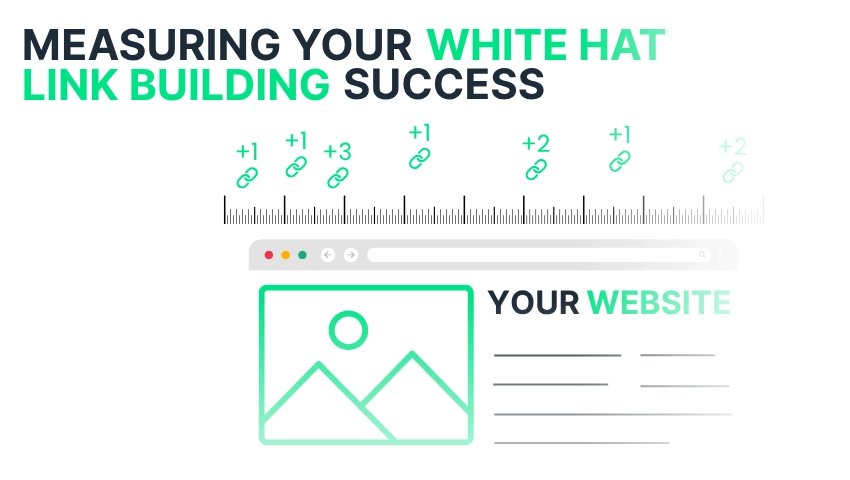
Tools that support white label link tracking can also help. They show you when a link goes live and how it performs over time. When you combine this data with backlink profile analysis through Google Search Console or platforms like Ahrefs, it becomes much easier to see which links are delivering genuine value. Metrics such as topical relevance, editorial placement, and anchor clarity matter far more than raw link counts.
It is also important to understand the risks. Google issues penalties when links are bought, automated, or created in unnatural patterns. Ethical link building avoids these issues entirely, which means you should never have to deal with Google penalty removals or emergency clean-ups.
If you use these signals consistently, it becomes easier to refine your tactics and drop anything that no longer contributes to long-term, defensible growth.
Discover other ways to boost your online presence
Improving your online presence starts with the simple fixes that strengthen your entire site. Here at Bazoom, we’re experts at helping you understand and improve your online presence. We can help you earn relevant editorial links. But those links work far better when your pages already give Google clear signals. Before you look at wider link building, check the basics: Pages that load quickly, headings that tell readers what to expect, and content that answers the main question without confusion. The team here at Bazoom can jump in and assist you with this.
Read a few key pages as if you were seeing them for the first time. Small gaps stand out more clearly that way. A section that drifts off-topic. A thin explanation. A guide that needs one more example to feel complete. Fixing details like these strengthens the E-E-A-T signals Google relies on. It also gives link building agencies, such as Bazoom, stronger material to promote. If you want your link building to deliver meaningful results, tightening your core pages is one of the most effective places to begin.
Other elements influence visibility, too. Internal links help readers and search engines move naturally through your content. Structured data gives Google useful context without changing the page itself. Fixing slow loading or broken paths removes small frustrations that push people away. These improvements may seem minor on their own, but together they shape how trustworthy your site feels and make it easier for Bazoom to secure placements that matter.
Once your foundation is in good shape, it becomes easier to judge what to build next. If you want to combine strong on-page signals with reliable link building, Bazoom can turn that groundwork into placements that support long-term visibility. This can help your business get seen online.
Why ethical link building matters in today’s SEO landscape
Ethical link building matters because modern algorithms now reward authenticity over shortcuts. Google’s helpful content and spam policies made that direction unmistakable. These updates favor pages built for users, and the links supporting those pages must follow the same principle. When an editor links to your content because it genuinely helps their readers, that signal stays strong through ranking updates. Start by reviewing how your current backlinks were earned and whether they match today’s standards.
Ethical link building follows this user-first mindset. It is rooted in relevance, editorial judgment, and trust. White hat link building services focus on earning placements from reputable sites that find your work useful. These inbound links sit naturally within the content and give readers something worth exploring. They may take longer to secure, but white hat backlinks keep their value because they are chosen for quality, not convenience. Take time to audit your backlink profile and identify which links strengthen your authority and which ones need replacing.
Unethical link building works in the opposite way. Automated links, private networks, and paid placements can create short bursts of visibility, but they leave patterns that Google detects quickly. When those patterns appear, rankings often drop as fast as they rose, and recovery can take months. Clean up anything that looks risky before it turns into a penalty that slows your entire site down.
White label backlinks earned through ethical outreach give search engines the signals they depend on. At Bazoom, our approach reflects that. Our placements come from genuine editorial decisions made by publishers who see real value in your content. This strengthens your authority without exposing your site to unnecessary risks. If you want your link building success to move onto safer, more sustainable ground, partnering with an ethical provider like Bazoom is one of the most reliable steps you can take.
In an SEO landscape driven by authenticity and user value, ethical link building remains the only approach that delivers long-term visibility, resilience, and trust. How? Through focused link building efforts.
The importance of high-quality content in white hat backlinks
High-quality content is the engine behind every strong white hat backlink. Even the best outreach falls flat if the page you are pitching is thin or unfocused. Editors link to pages that make their own work better, and Google rewards the same thing. That is why the most successful white hat strategies start with content worth referencing to secure backlinks.
The pages that naturally attract links usually share a few traits. They give readers something practical, clear, and genuinely helpful, often in one of these forms:
- Guides that walk someone through a problem from start to finish
- Research-backed resources that add data rather than opinion
- Insights drawn from real experience in a field
- Expert commentary that helps readers understand a change or trend
To Google, strong content comes down to relevance, usefulness, and originality. A page that answers a clear question and adds its own perspective is more likely to earn links that stay in place over time. When your content meets those expectations, it keeps its value even as algorithms change.
You can see this during outreach. Strong pages are easier to pitch because you can show exactly why they help a publisher’s audience. That clarity often leads to better responses and white hat backlinks that last because they belong there. Over time, these pages often attract additional links on their own as more readers find them.
Get started, and boost your ranking with Bazoom
Strong white hat link building always starts with strong content. When your page answers a question clearly and offers something genuinely useful, editors can see why it helps their readers. That is what makes white hat links possible. Even the best white hat link building techniques rely on quality content. This is because links earned from value, not shortcuts, are the ones that last.
The good news is that building this foundation is simpler than most people expect. You do not need complex tools or endless tactics. You need a solid page, a relevant audience, and a way to reach the editors who serve that audience. A real link building example almost always follows the same pattern:
- Create something useful that answers a question clearly
- Share it with editors who cover that topic
- Earn a natural placement when it improves their page
- Build authority, as those white hat links stay in place over time
Bazoom makes each part of this easier. Instead of sending cold outreach into the void, you work with a platform that understands what editors expect. We know how to approach them at the right moment. You bring the expertise behind your content, and we at Bazoom will support you with the relationships and structure needed to earn placements that carry real authority.
If you want to grow through ethical white hat link building, reach out and let us help set that process in motion. And if you need support beyond white hat links alone, Bazoom can guide you through the other steps that strengthen your online presence and help your business get seen.