Link Building as a GTM Tactic: How B2B SaaS Can Win in Target Markets
Jump to section [Open]
Most B2B SaaS companies, while beginning to put into practice their go-to-market strategy, start with significant investment in clean websites, nicely refined design, and well-crafted content. Companies give a considerable amount of thought and a considerable share of their marketing budget to these assets. However, the truth is cruel: 96.55% of all web pages are getting zero organic traffic since they did not receive any backlinks and other signals to support SEO. Even good content will not be seen without being distributed.
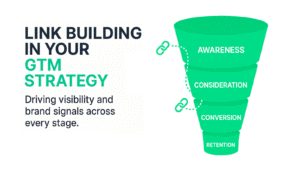
This is one of the largest GTM strategy errors.Too many companies forget that it is not sufficient to create content, it must also be made accessible and visible. Link building is only regarded as a mere method of SEO but it is in fact a tactical move that will make something visible in the right markets. When backlinks are added as a side note, they would not be able to give their full potential. Companies can gain considerable visibility, credibility, and competitiveness by incorporating link building into their GTM planning, even at the design phase.
Link building as a GTM tactic:
|
The Real Meaning of a GTM Strategy
A GTM strategy is not a marketing plan. It is an organization that aligns sales, marketing, product and customer-success departments around shared business goals. The structured GTM strategy answers some basic questions: Who is your perfect buyer, how do you differentiate your product in the market, and what are the most effective channels to reach your audience?
The main benefits of GTM strategy are:
- Reaching the right buyers who are in need of the solution
- Developing a unique market position
- The selection of the optimal channels of communication and sales
- Adapting with a constant input of the market
Although they may sound like simple building blocks, experience shows that the majority of businesses have no formally written GTM strategy. For some the strategy is a list of marketing plans or a few Google ads. That will use only a small portion of the growth potential – both in sales and organic exposure.
The Actual GTM Enablers
At Magoom, we consistently find that effective market penetration is a function of several important enablers. The initial one is live contact. Brand reps, business development people, and salespeople who attend trade shows, conferences, and industry events are going to get to the niche customers and partners way earlier than those who do not. These physical interactions do not simply display the product, they create trust-based relationships which can often lead to an additional benefit – backlinks of high quality websites. This mirrors the findings from my Master’s thesis at ISM University of Management and Economics, “B2B SaaS Product Go‑to‑Market Strategy Execution in CEE Immature Markets: Barriers and Enablers”, where live contact emerged as a top driver of success.
The second enabler is the selection of proper segmentation. Rather than attempting to attract everybody, it is much better to target a vertical niche. Narrower positioning enables production of expert, targeted material which will be crosslinked with industry movers and shakers.
Third is the on-going experimentation. There is no single straight path to entering a market; it is a loop of trial and error, lesson and pivot until you get to the right section which responds in the same way. And it is such a trial and error strategy that helps businesses to find their perfect audience and eventual purchasers.
Using Offline Events to Develop Links
Probably the least used tactic of GTM is combining offline events with digital PR. What occurs during an offline event can, and should, be transferred to the web. During expos, in-person demos, or at conferences, leads obtained are likely to appear in press releases, partner newsletters or industry blogs. Each of these touchpoints can produce high-quality backlinks.
This kind of offline online synergy is particularly beneficial. By attending a conference abroad, a company not only gets visibility to the foreign conference participants but also hosts its own conference that the media will cover. Online PR efforts – e.g. interviews, press releases, or collaborative efforts with the media – increase offline presence and create brand credibility.
The backlinks acquired in such a way are usually on high-authority pages, which also carry high SEO value.
GTM Metrics: Checking the Effect of the Link Building
The counting of backlinks is insufficient. When winning in target markets is the objective of a GTM strategy, winning should be quantified using wider business KPIs. To illustrate, has link building helped to reduce customer acquisition cost (CAC)? Has it increased retention levels?
There should always be a practical business result of the backlinks. The presence of quality links adds brand authority, and it has ramifications on the organic traffic, but also sales conversion. Those companies who are able to quantify this relationship and demonstrate the same show that investment in building links is justified.
The Place of Link Building in the GTM Framework
Once you are clear as to your ideal customer and your niche, then your content must be addressed to their specific issues. Such is the type of information that potential customers and link building partners will be seeking. Long-form, information-supported resources, such as detailed analysis, research study, or market report, are the best. Such resources naturally attract citations and quality backlinks.
The essential content must also be valuable, and technically viable to be delivered online. That contains clear structure and strong SEO foundations. Valuable and technically correct content serves a dual purpose – driving GTM objectives and generating backlinks.
In recent years, digital PR has become an essential tool in the arsenal of SEO professionals, whose value is increasing more and more. Unlike mass guest posts or directories, digital PR garners backlinks with reputable sources of information: national and international media, industry publications, and networks of influencers.
A link with a high authority can lead to a domino effect whereby other blogs and media will tend to link back to the article which spawns a chain of backlinks. Such signaling does not just improve organic visibility, but also creates E-E-A-T (Expertise, Experience, Authority, Trust) – Google trust signals when they evaluate content. Development of such signals contributes to the success of GTM because it makes your brand credible in markets that you need to enter.
Original and AI-Optimized Text
Lastly, it is important to acknowledge the fact that Google (as well as any other search engine) is biased toward deeper insights and new perspectives. There is little permanence in thin surface or mass-produced AI content. The companies should invest in independent research, proprietary opinions, and reliable sources to create link-worthy content that helps the company achieve its GTM goals.
As that occurs, AI takes a more central role in content discovery and ranking, hence it is worth maximizing to AI bots:
- Get AI bots (e.g., GPTBot, PerplexityBot) to crawl your content
- Use server-side rendering or pre-rendering in order to be completely visible
- Create an /llms.txt to make it clear what the AI bots may index
- Arrange the material with strong H1/H2/H3 headings, start each section with a clear answer, and focus on one idea per section
- Prepare a citable-ready content: well-known author names, dates of publication, URLs to the sources, structured data markups
Such activities do not only raise the visibility of searches, but also raise the probability of your content being cited.
The practice of link building is not an SEO gimmick but it is a component of GTM. To ignore it is to become invisible in your target markets and be denied a growth opportunity. By integrating link building at the very start of your digital strategy and connecting offline activities with digital PR, and constant creation of fresh content grounded in data, B2B SaaS companies can not just secure higher organic rankings, but measurable business growth.
About Vytautas Majauskas:
Vytautas is a marketing strategist with deep experience in digital marketing and B2B go-to-market development. His career includes leadership roles as Chief Marketing Officer at Frontu and Spotos, and Head of Marketing at Oxylabs. Today he consults companies on digital marketing and GTM strategy and is the founder of Magoom, a boutique marketing agency.
About Magoom:
Magoom is a top marketing and SEO agency in Lithuania (rated by Clutch and GoodFirms). Studio focused on building digital strategies for go-to-market execution and customer acquisition. By applying a data-driven approach, understanding the specifics of new product launches, and tailoring digital marketing solutions to each client, Magoom ensures brand growth and maximum ROI.