Discover the basics of PBN links and their role in SEO
Jump to section [Open]
When people in SEO talk about PBNs, they’re referring to Private Blog Networks. These are a collection of websites created primarily for passing authority from one site to another. If you’re asking yourself what PBN links are or what a PBN is, you’ve come to the right place. The simplest explanation is this: It’s an artificial network designed to influence rankings.
A PBN is built by purchasing expired or aged domains. These domains already have authority. The owner rebuilds these sites, intending to link out to a main website. The hope is to boost the ranking. Even though PBN in SEO tactics has been around for a while, search engines consider them manipulative. Getting caught can lead to penalties or de-indexing. Nonetheless, site owners are still experimenting with PBN SEO methods. Why? They promise quick gains.
Organic links, by contrast, are earned naturally. This is done through reliable content and relationships. This makes them stable and safer long-term. Organic links take time and patience. The links pointing toward authenticity always do. PBN links take finances, knowledge, and technical craftsmanship. You need to understand the difference between the two. This is critical, as only then can you make an informed decision regarding relevant links.
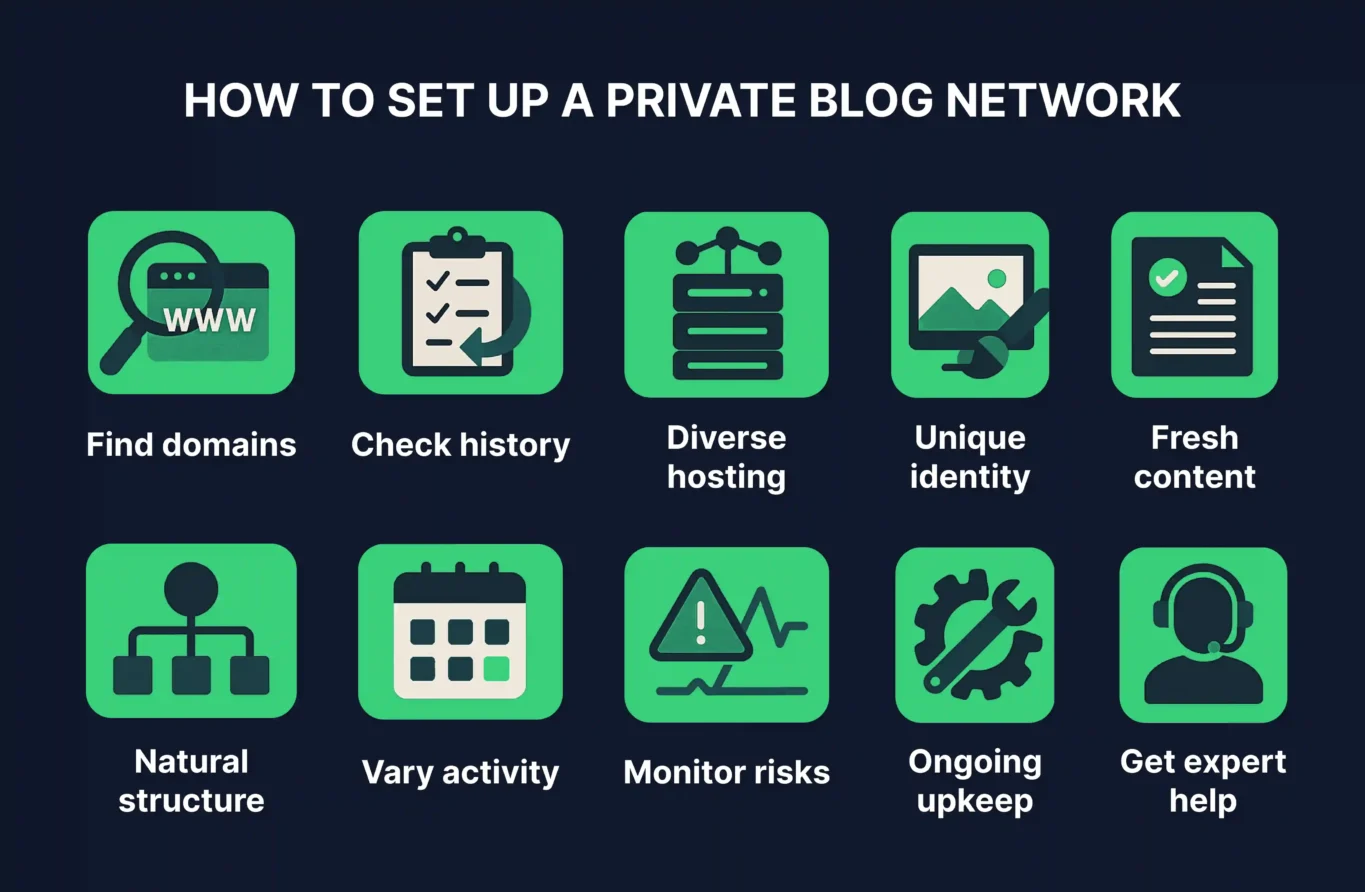
How to set up a private blog network step-by-step
If you’ve ever looked into PBN sites or thought about using a PBN building service, consider these steps below. At first glance, PBN links may seem straightforward but they can come with serious penalties and risks.
Here is your guide:
Step 1: Find quality expired or aged domains
Start by searching for domains that still hold genuine authority to alleviate your PBN links SEO workload. Avoid anything with a spam-heavy history. You want strong domains for your PBN network to work and build links. Be careful about how you do this. Even the first step in the process comes with high risk.
Step 2: Verify the domain’s past
Check previous ownership, e.g., if there were many PBN owners. Look at old content and backlink quality. Also, identify private blog networks. A domain with penalties can harm your entire network.
Step 3: Use diverse, footprint-free hosting
Each site needs to look independent. That means different IPs, hosting providers, and sometimes different CMS setups to avoid detectable patterns on your PBN website. If there are footprints left, there is a higher risk of detection.
Step 4: Give every site a unique identity
Use different themes, logos, layouts, and tones when building a PBN. Repeating designs or content structures makes the network easier to spot. Our knowledge at Bazoom is helpful in this regard.
Step 5: Publish original, natural content consistently
Each site needs fresh, relevant articles that appear genuine, as a private blog network PBN. Thin or duplicated content raises are not ideal. You want to score high in search rankings, after all. PBN may be your strategy, but remember that it does not come without risks.
Step 6: Build natural site structure
Add internal pages, categories, and outbound links to authoritative sources. A site that only exists for linking is easy to detect. Don’t fall for broken link building, as this makes PBN even more risky.
Step 7: Vary behavior across the network
Keep posting schedules, content types, and link patterns differently. Uniform activity makes the network look controlled, even if it’s only an illusion.
Step 8: Monitor performance and risks
Track indexing, traffic, backlinks, and technical issues. Search engines evolve constantly, so risk levels change over time.
Step 9: Be prepared for ongoing work and costs
PBNs require continuous upkeep, fresh content, and hosting expenses. It’s not a passive or risk-free strategy.
Step 10: Get guidance before using PBNs in your strategy:
If you’re considering adding PBNs to your link building approach, get expert advice. Here at Bazoom, we can help steer you toward a safer and more effective link building tactic.
Using PBNs in your link building strategy: Pros and cons
PBNs get used in SEO because they pass link equity from multiple sites to one destination quickly. When someone invests in SEO PBN backlinks, the hope is for more authority and a rank boost. The aim of SEO is to be an authority, not to fill a site with unnatural links. Organic backlinks do just this. Using SEO PBN backlinks can be an option, however, with more risk. Is it really worth it?
Search engines have evolved. PBN link building carries real detection risks. If your PBN strategy looks too coordinated, it can lead to manual reviews or algorithmic red flags. To cover up the signals, some site owners have tactics. They try to blend PBN links with outreach or ecommerce link building. This varied backlink network reduces but does not eliminate the ethical and technical issues.
Link building PBN offers speed but not stability. PBN link building is a short-term strategy and not a long-term one. You may get fast movement, but you’re also opening the door to penalties if not done expertly. Your long-term goals deserve a strategy that won’t die out when search engine bots come crawling.
How to spot a PBN: Signs and red flags
Most weak PBN setups reveal themselves through a few consistent patterns. You can easily tell a weak PBN network SEO or private blog network links, if you notice these three things:
- Reused website templates: When several blogs share the same layout, structure, or design style, it often signals that they’re part of the same backlink PBN setup. Legitimate sites usually have unique branding. This means that identical templates across different domains should raise your suspicion.
- Weak content quality: Thin posts, spun text, or articles that jump between unrelated topics are common traits of low-effort PBN sites. A private blog network links portfolio often focuses on publishing just enough content to look active. But this is not enough to feel credible or useful.
- Unnatural backlink clusters: This happens when a site links out to too many unrelated niches or shows patterns that look engineered rather than earned. This indicates that you may be looking at PBN network SEO activity. These clusters often appear forced and lack the natural relevance you’d expect from genuine editorial linking.
When you ask yourself, “What is a private blog network?” your answer should never include the three bullet points listed above. PBN links’ meaning is authority and clarity, not low-quality content, spammy backlinks, or suspicious links.
Ways to keep your backlink profile safe from PBN risks
A healthy backlink profile protects you from potential penalties. Start by performing regular audits to keep your site’s reputation clean. Monitoring tools can help you identify links from known PBN domains before they become a problem. When you spot a suspicious URL, remove it before it affects your PBN backlink strategy.
Building a strong profile means balancing links. You need a good mix of dofollow and nofollow links from relevant and trusted sources. This is far more valuable as a backlink network than a low-quality PBN backlink strategy. When it comes to “How to build PBN links?” don’t take any shortcuts.
With backlinks PBN, you’re better off focusing on dependable sources, reputable partners, and long-term trust signals. If you have found reliable sources to buy PBN domain traffic, you can consider this, but know it comes with certain risks.
What happens if Google catches your PBN?
Why is all of this private blog network (PBN) talk important? If Google detects a PBN attached to your domain, it’s not good. Your Google search results should be positive and not negative. If they’re negative, the search engine can issue a manual action. It can also de-index the PBN sites or drop your rankings significantly. This usually happens when patterns reveal themselves through:
- Link spikes
- Identical anchors
- Authority jumps (sudden ones)
It’s not worth it because the climb back to your original ranking is a slow one. The Google penalty is high. To avoid it, you must understand that there is PBN SEO meaning behind how content works. You need high-quality content and not quick PBN links for sale. If Google thinks you used manipulative backlinks, you’ll need to remove the offending links. You will also need to file a reconsideration request. This takes effort and time, both of which you’d prefer to invest somewhere more meaningful.
Why the ethics of PBNs matter in SEO
Using PBNs may seem tempting for quick SEO PBN growth. But it breaks trust with both users and search engines. Sites that rely on PBN private blog network strategies undermine fair competition on search engines. When you think “What is PBNs?”, you can’t forget about ethics. You should also not forget to question the impact of PBN blog post backlinks and the PBN’s meaning behind all of this. By focusing solely on PBN building, you risk your authority and trustworthiness with search engines.
PBN blog post backlinks pull you away from sustainable and user-focused SEO. When you invest in quality instead of manipulation, you’re building something that lasts. That’s why focusing on ethical, guideline-aligned practices is always the smarter long-term move. So, what is a PBN link? It’s a strategy that should not be used in isolation. By creating healthy link networks, you gain more authority in search engines. Plus, you harvest far more trust with online visitors.
Real cases of PBN penalties: Learn from others’ mistakes
PBN penalties are serious. Stories of PBN penalties aren’t hard to find. Many site owners who thought they had the perfect setup experienced sudden ranking crashes. These were caused by PBN domains with backlinks they bought or a poor PBN domain SEO tactic. The penalties tend to show up the same way: a notification in Google Search Console. Or a quick downward trend in analytics.
In one hypothetical example, a small e-commerce brand relied on a handful of PBN domains as SEO sources. At first, traffic increased. Then, a manual action hit, and the site’s visibility dropped by more than half. To recover, the owner had to disavow links, remove offending connections, and wait weeks for a reconsideration review.
Financially, the damage can be huge. Lost rankings lead to lost revenue, and cleaning up the mess takes time. When someone asks what PBN backlinks are or what PBN link building can do, these stories show the full picture. Shortcuts come with a price. It’s not worth it.
White hat link building: The safe alternative to PBNs
White hat link building is your best long-term approach when you’re looking for long-term growth. Unlike PBN blog tactics or buying PBN links that can put your site at risk, these methods are:
- Transparent
- Ethical
- Trusted
You can build authority in search engines by offering genuine value, not by trying to outsmart algorithms. It isn’t the easiest process, but we’re here for you every step of the way. Get in touch with us today to find out more about our white hat link building services.
“Building your authority online takes time. But more than this, it takes a strategy. Here at Bazoom, we know exactly which strategy to implement to create an effective plan for your business. This is expertly vetted, thorough, but most of all, safe. It won’t bring you headaches or penalties.”
– Nikolaj Østergaard, Co-Founder at Bazoom Group

Start with guest posts on reputable sites. Digital PR is another powerful option, helping you get featured in articles, interviews, or expert roundups. These methods support link building PBN alternatives that have a long-term focus. You can also use content marketing to generate natural mentions. When people share your resources because they find them useful, you earn links that are far stronger than SEO PBN links.
Would you like more ideas? Think about opportunities for spokesperson quotes or HARO submissions. These methods bring you visibility and authority. If you want to integrate ecommerce link building, you can reach out to industry partners or influencers. Find ones who already speak to your audience so that your target is met.
Why great content beats PBNs every time
High-quality content is the answer to your SEO strategy. When you create something useful, people want to reference it. You don’t need PBN blog post backlinks when you produce guides, infographics, studies, or original research. It’s quality content you need to work toward, so forget the PBN sites and PBN websites. Throw your question of what PBN in SEO is out and focus instead on quality content.
Here are some tips to create great content:
- Publish consistently
- Keep your articles fresh
- Optimize on-page elements
- Create search engine content value
Strong content helps your site earn positions organically and sustainably. Here at Bazoom, we can help you with this. You can contact us now, and we’ll be in touch to help create an SEO strategy. We will give you the tools you need to never look at PBN blog post backlinks again.
“We are here to help you understand that great content, filled with high-quality links that aren’t PBN-focused, is your secret weapon. The key is consistency, optimization, and thoroughness. We can help improve your SEO strategy in no time.”
– Tamara Novitović, Head of SEO at Bazoom Group
Building real relationships for the best organic links
Strong connections in your industry often lead to the best organic backlinks. When you collaborate with experts or influencers, you get genuine endorsements. These far outweigh anything you’d get from PBNs, meaning artificial networks aren’t your answer. You should look for organic networks. This can be achieved through interviews, guest features, or shared projects. These relationships create trust and are organically built.
You can also co-create content or participate in roundups. Each interaction opens a door to more visibility and higher-quality mentions. We focus on authentic content, trustworthy links, and solid strategies that improve your visibility the right way. No PBN link in sight.
Nothing matches the value of editorially earned links. As algorithms evolve, authenticity stays key. Instead of wondering “What is a PBN site?” or exploring PBN SEO shortcuts, you’re building a foundation that lasts. Even if you consider buying PBN domains with backlinks, genuine connections still outperform those shortcuts.
Get in touch with us if you want to improve your authority and trust by using the best organic links out there.