How to Build a Link Building Brief That Agencies Actually Follow
Jump to section [Open]
Every link building campaign that goes sideways has the same root cause, and it is rarely the agency.
It is the brief.
After running campaigns across 65+ markets and working with hundreds of agencies and in-house teams, we see the same pattern: the briefs that produce good links are detailed, opinionated, and a little bit annoying to write. The briefs that produce mediocre links are short, hopeful, and full of phrases like “high authority sites in our niche.”
This piece walks through how to write the first kind, with a downloadable template at the end you can adapt for your own campaigns.
Why most link building briefs fail before the first outreach email
A bad brief does not fail because it is too long or too short. It fails because it offloads decisions onto the agency that only the client can answer.
Here is what that looks like in practice. A client sends a Notion doc with three lines: target the homepage, anchor mix is up to us, get the highest DR you can. The agency does its best, places eight links over the month, and the client rejects four of them because the publisher “does not feel right” or the anchor “is too commercial.”
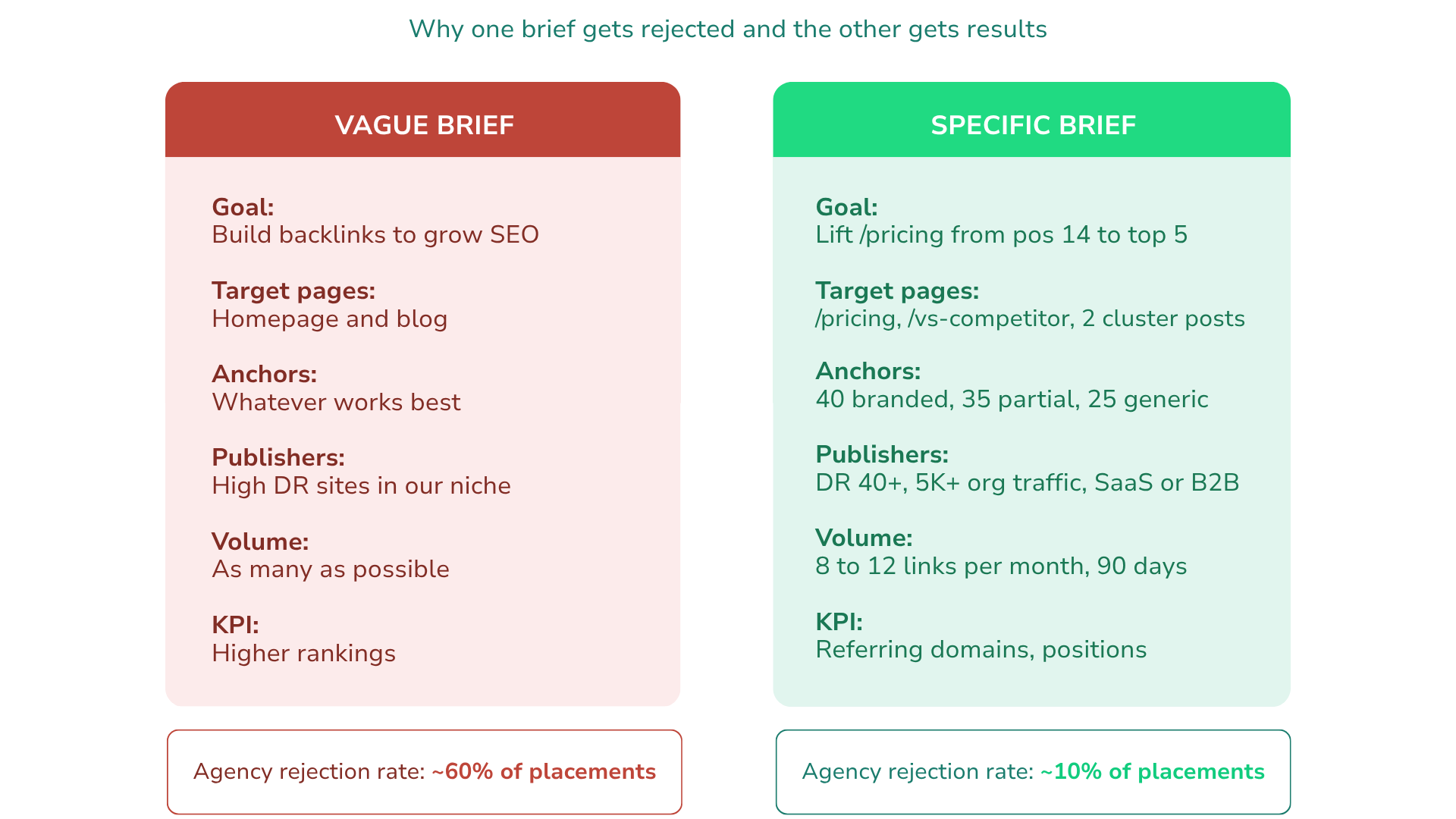
Neither side did anything wrong. The brief just never told anyone what right looked like.
A real brief makes the agency’s job binary. Every placement either matches the criteria or does not. There is no debate about taste, fit, or feel, because all of that was written down before outreach started.
What we see most often
Across our publisher network, agencies report that roughly 60% of placement rejections come from criteria the client never specified in the brief. Most of those rejections are avoidable if the brief did its job.
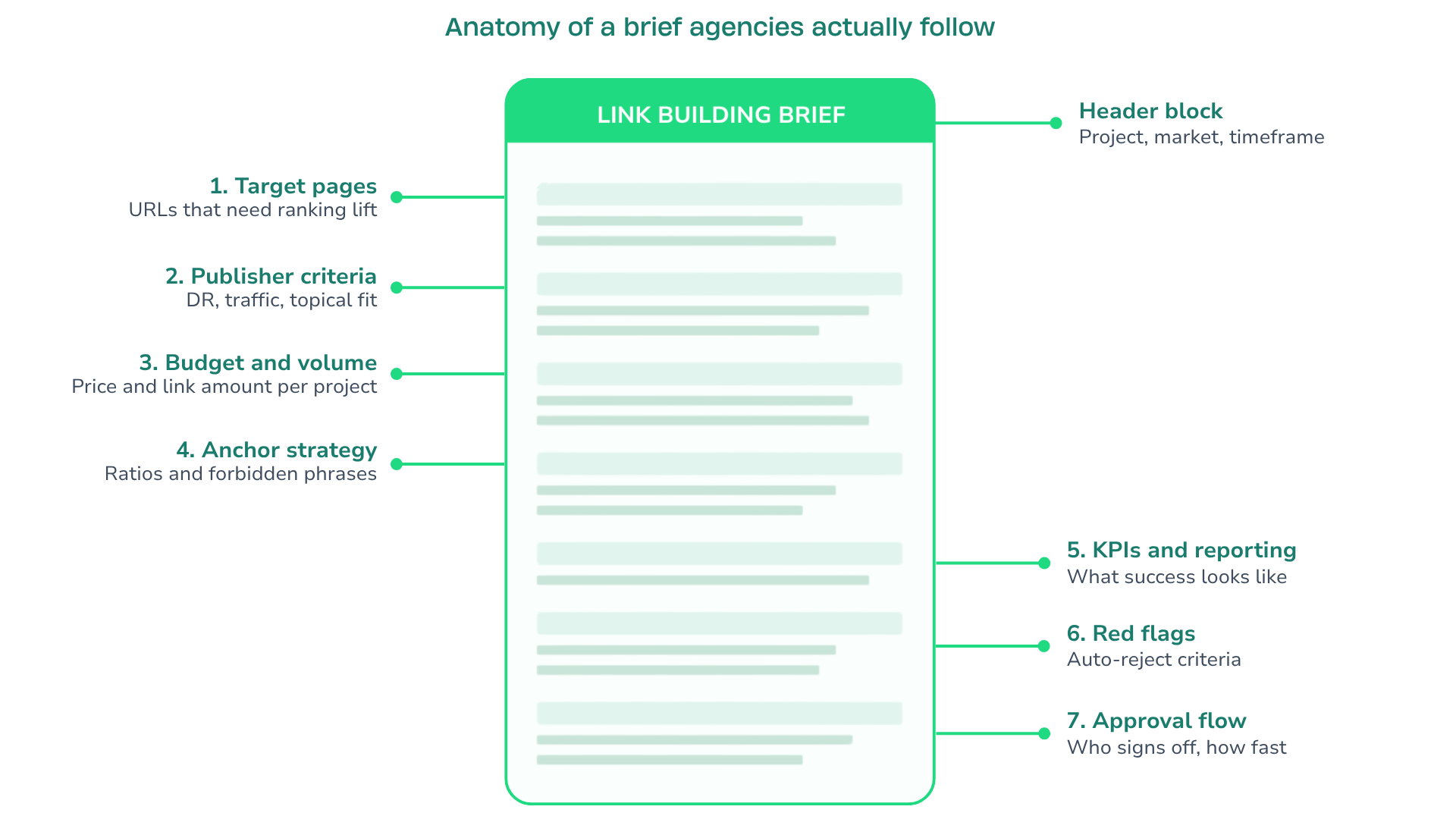
The seven sections every brief needs
There is no universal brief template, but every good one we have seen covers the same seven areas. Skip any of them and you are creating ambiguity an agency will have to fill in for you, usually in a way that costs you money or links.
1. Target pages and the ranking job to be done
Start with the pages that need links and why. Not “the homepage,” but the specific URLs, their current positions, the keywords they should rank for, and where you want them to be in 90 days.
A page sitting at position 14 needs a different link profile than a page sitting at position 4. A new product page with thin content needs different links than a pillar page with 4,000 words and 30 internal links pointing to it. The agency cannot guess at this. Spell it out.
What to include: URL, current position, target keyword, current backlinks, target position, internal page priority (primary, secondary, supporting).
2. Anchor text strategy with actual ratios
“Use a natural anchor mix” is not a brief. It is a shrug.
Give the agency real ratios. For most campaigns we run, the split looks something like 40% branded, 25% generic (click here, read more, this guide), 20% URL or naked link, 10% partial match, 5% exact match. These numbers move depending on the page’s existing profile, the vertical, and how aggressive the campaign is, but they are numbers, not vibes.
Also list the anchors you do not want under any circumstances. If “best crypto casino” is off-limits because of regulation, write it down. If your legal team has flagged certain phrases, those go in the brief too.
3. Publisher selection criteria
This is where most briefs collapse into the phrase “high DR sites.” Domain Rating alone is a terrible filter and we have written about that elsewhere. Your brief needs real criteria that map to your actual quality bar.
Hard requirements: minimum DR, minimum organic traffic (and from which countries), maximum spam score, language, topical category.
Soft preferences: editorial standards, presence of author bylines, ratio of guest content vs original, whether the publisher takes payment openly, how many outbound links per page is acceptable.
For competitive verticals like iGaming, finance, and crypto, soft preferences are often what separates a link that ranks from a link that gets discounted by Google three weeks after placement.
4. Velocity, volume, and timeline
How many links per month, over how many months, and what happens if a month falls short. Agencies need a target to plan outreach against, and clients need to know what realistic looks like.
A 12-link campaign delivered in week one is a different campaign than 4 links per month for three months, even if the totals match. Decide which one you want and write it into the brief.
5. KPIs and what reporting looks like
This is the section clients tend to handwave through, and it is the one that causes the most arguments at the three-month mark.
Define what success means before the campaign starts. Is it referring domains? Position movement on the target keywords? Organic clicks to the target pages? Some weighted blend of all three? Pick one or two primary metrics and write them down. Then specify how often the agency reports, in what format, and which dataset is the source of truth (your Ahrefs, theirs, GSC, or all three).
6. Red flags and auto-reject criteria
This is the section most briefs are missing entirely, and it is the one that saves the most time.
List everything that is an automatic no, before placement. Examples we use often:
- Sites with more than 50% outbound dofollow links per page
- Sites with sudden DR or traffic spikes in the last 90 days
- Sites flagged in our spam list (link to it)
- Sites in markets we do not target (and why)
- Anchor text containing competitor brand names
- Placements behind a paywall or inside a sponsored content section
Every campaign has its own version of this list. The point is to have one.
7. Approval workflow
Who signs off on a placement before it goes live? How fast? What happens if approval takes longer than 48 hours?
Slow approval kills more good placements than bad outreach does. If your approval flow runs through three stakeholders across two time zones, the brief needs to say so, and the timeline needs to account for it. Otherwise the agency loses publishers who will not hold a slot for a week.
Two things to leave out
As important as what goes in is what does not.
Leave out tactics. Do not tell the agency to use HARO, broken link building, or any specific method. You hired them for execution. Tell them what good looks like and let them pick the path.
Leave out flattery. The brief is not a pitch deck. “We are an exciting fast-growing brand in the AI space” tells the agency nothing. Cut the marketing language and replace it with facts.
The Bazoom brief template
We have packaged the seven sections above into a working template you can fill in and send to any agency or in-house team. Pick the version that fits your campaign.
Free download
The Bazoom Link Building Brief Template
Two versions, depending on how much detail your campaign needs.
A few notes on how we use it internally:
- We fill in the brief once per quarter per client, then update only the target pages and KPI sections each month.
- The red flags section is treated as a living list. Every time a placement gets rejected, we ask whether the rule should be added to the brief permanently.
- We share the filled brief with the agency in a read-only format. Changes go through a quick comment thread, not a new version of the doc.
This is not the only way to write a brief. It is the way that has produced the fewest arguments and the most consistent campaigns across the work we have shipped over the last two years.
If you read nothing else
The job of a link building brief is to make every placement decision binary. If the agency has to ask whether a site “feels right,” the brief failed. If a placement gets rejected after going live, the brief failed.
Write it once, write it properly, and the next six months of your link building campaign get a lot quieter.