
Link Building for Lawyers: The Complete Guide to Building Authority and Attracting Clients in 2025

Jump to section [Open]
Here’s the reality: 92% of potential clients use Google to find legal services. If your law firm’s website isn’t appearing in those crucial first few search results, you’re essentially invisible to the clients who need you most. The key to ranking higher lies in quality backlinks, its a digital endorsements that signal to Google your content is trustworthy and authoritative.
Link building for lawyers is more than just an SEO tactic; it’s the foundation for reaching clients in a competitive legal landscape. Law firms with strong link building strategies see a direct correlation between quality backlinks and improved search rankings, client acquisition, and revenue growth. This guide will help you understand how to identify high-quality backlinks, implement effective strategies, avoid common pitfalls, and measure the ROI of your link building efforts.
Wanna skip the hassle and go straight to acquiring backlinks? Check out our guide on the best place to buy backlinks.
What is Link Building for Law Firms?
Link building is the practice of acquiring hyperlinks from other websites to your law firm’s site, serving as digital endorsements that highlight your expertise and credibility. Search engines like Google use these inbound links as key ranking signals, considering not just quantity but also the quality, relevance, and authority of the referring domains.
For law firms, backlinks from reputable legal directories, bar associations, and legal publications carry significant weight, as legal services demand higher trust. Understanding the difference between inbound links (total links) and referring domains (unique linking websites) is crucial since search engines favor diverse, authoritative sources over multiple links from the same site.
This is especially important in the legal industry, where search engines closely evaluate backlinks due to trust factors. A single high-quality backlink from a state bar association can outweigh many low-authority or irrelevant links. For example, if a legal publication links to multiple pages on your website, these count as several inbound links but only one referring domain, highlighting the value of unique, relevant websites linking to your firm. Ultimately, a strong backlink profile from authoritative external sites boosts your law firm’s search rankings, visibility, and credibility, helping you attract more clients in a competitive market.
What Makes a Good Backlink for Lawyers
Not all links are created equal, especially in the legal industry where trust and authority matter more than in most other sectors. Understanding how to evaluate link quality will help you focus your link building efforts on opportunities that actually move the needle for your law firm’s online presence.
High-quality backlinks for law firms share several characteristics:
Authority signals go beyond simple domain authority scores. While metrics like domain rating provide useful benchmarks, the actual traffic and engagement of the linking site matter more. A legal blog with a domain authority of 40 but strong reader engagement and regular citations by legal professionals often provides more value than a generic business directory with a domain authority of 60.
Relevance factors specific to legal practice areas make certain links particularly valuable. A link from a personal injury law blog carries significantly more weight for personal injury attorneys than a link from a general business website. Search engines understand these topical relationships and weight relevant links more heavily in their ranking algorithms.
Editorial context and natural link placement distinguish earned media from directory listings. Links embedded naturally within article content, case studies, or legal analysis pieces signal genuine endorsement.
Here are examples of high-quality versus low-quality backlinks for law firms:
High-Quality Backlinks:
-
Feature articles in state bar association publications
-
Guest posts on established legal blogs like Above the Law or ABA Journal
-
Citations in legal research papers or law school resources
-
Local news coverage of significant cases or legal developments
-
Professional directory listings in specialized legal databases like Martindale-Hubbell
Low-Quality Backlinks:
-
Generic business directories with no editorial oversight
-
Comment sections on irrelevant blogs
-
Link farms or private blog networks
-
Reciprocal link exchanges with non-legal websites
-
Directory submissions to low-authority sites
The importance of editorial context cannot be overstated. A backlink embedded within a 2,000-word analysis of recent personal injury law developments carries exponentially more weight than a simple directory listing. Search engines evaluate the content surrounding your link to determine its relevance and value.
Do-Follow vs. No-Follow Links
Understanding the technical distinction between dofollow and nofollow links helps optimize your link building strategy, though both types provide value for law firms.
Dofollow links pass ranking authority (often called “link juice”) from the linking site to your law firm’s website. These links directly influence your search engine rankings and should be the primary focus of your link building campaigns. Most editorial links from legal publications, news sites, and professional associations are do-follow by default.
Nofollow links include a special HTML attribute that tells search engines not to pass ranking authority. However, dismissing nofollow links entirely could be a mistake. These links still provide several benefits for law firms:
-
Referral traffic: Readers clicking through from reputable legal sources can become valuable clients
-
Brand visibility: Citations in major publications build recognition even without ranking benefits
-
Natural link profile: A mix of do-follow and no-follow links appears more organic to search engines
-
Relationship building: Engaging with legal publications often leads to future do-follow opportunities
Major legal publications and news sites often use nofollow links in their standard editorial policies, but the traffic and credibility benefits justify pursuing these opportunities. The key is maintaining a natural balance rather than exclusively chasing dofollow links.
Anchor Text Best Practices
The clickable words that contain the link is called an anchor text. It plays a crucial role in how search engines interpret your backlinks. For law firms, anchor text optimization requires careful balance between SEO benefits and natural language patterns.
Natural anchor text variation prevents over-optimization penalties while still signaling relevance to search engines. Instead of repeatedly targeting exact-match keywords like “personal injury lawyer,” use variations such as:
-
“Smith & Associates personal injury team”
-
“experienced personal injury attorneys”
-
“the firm’s legal expertise”
-
Your law firm’s brand name
-
“this comprehensive legal analysis”
Avoiding over-optimization penalties requires understanding Google’s spam filters. If a high percentage of your backlinks use identical anchor text, search engines may flag your link profile as manipulative. Aim for a diverse mix around:
-
33% use of branded anchor text (your firm name)
-
33% use of variations of your target keywords
-
33% use of generic phrases like “click here” or “learn more”
Brand mentions and co-citations serve as ranking signals even without explicit links. When legal publications mention your law firm’s name alongside relevant legal topics, search engines understand the association and may boost your rankings for those terms. This phenomenon, called “implied linking,” means that building brand awareness within the legal community provides SEO benefits beyond traditional backlinks.
Proven Link Building Strategies for Law Firms
Effective link building for law firms requires a strategic approach that balances SEO benefits with professional credibility. The following strategies have proven successful across various legal practice areas and firm sizes.
Creating Linkable Legal Content
The foundation of any successful link building campaign starts with content that other legal professionals, journalists, and potential clients actually want to reference and share. Linkable assets goes beyond basic service pages to provide genuine value to your target audience.
Developing comprehensive legal guides and resources positions your law firm as an authoritative source within your practice area. These guides should address common legal questions with depth and accuracy that makes them reference-worthy. For example, a family law firm might create “The Complete Guide to Child Custody Laws in [State]” that covers recent legislative changes, court precedents, and practical advice for parents.
Successful linkable guides typically include:
-
Current legal statutes and regulations
-
Recent case law and precedents
-
Practical checklists and timelines
-
Frequently asked questions with detailed answers
-
Local jurisdiction-specific information
Writing data-driven articles on legal trends and statistics attracts links from legal publications and news outlets seeking credible sources. Law firms that conduct original research or compile relevant legal statistics often become go-to resources for journalists covering legal topics. Consider analyzing court filing trends, settlement amounts, or regulatory changes within your practice area.
Creating infographics and visual content for complex legal topics makes legal information more accessible and shareable. Visual content explaining legal processes, timelines, or statistical trends gets shared more frequently than text-only articles. For instance, a personal injury firm might create an infographic showing the steps in a typical personal injury claim, which could be referenced by legal aid organizations, other attorneys, and legal education sites.
Examples of successful linkable assets from law firms include:
-
Morrison & Foerster’s annual privacy law survey, cited by dozens of legal publications
-
Fenwick & West’s venture capital survey, referenced in business and legal media
-
State-specific DUI penalty guides that local news outlets reference during awareness campaigns
Backlinks from Legal Publications
Guest posting remains one of the most effective link building strategies for law firms when executed properly. The key lies in identifying appropriate publications and creating content that provides genuine value to their readership.
Too time consuming for you? At Bazoom we offer you free personalised backlink strategies.
Identifying high-authority legal blogs and publications requires research into your target audience’s reading habits and information sources. Focus on publications that:
-
Regularly publish content related to your practice area
-
Have engaged readership and social media presence
-
Accept contributions from external legal professionals
-
Maintain editorial standards and fact-checking processes
Media Partnerships and Journalistic Relations
Building relationships with legal journalists and reporters creates ongoing opportunities for media coverage and high-authority backlinks. Media relations require consistent effort but often yield the highest-quality links from major news outlets and legal publications.
Responding effectively to journalist queries requires quick turnaround times and relevant expertise. Most journalist queries have tight deadlines, often 24-48 hours, so setting up email alerts and responding quickly gives you a competitive advantage. Your responses should be:
-
Specific and directly relevant to the query
-
Include your credentials and relevant experience
-
Provide quotable insights rather than generic information
-
Include contact information for follow-up questions
Legal Directory Optimization
Professional legal directories remain a foundational element of law firm link building strategies. While some directories provide more value than others, strategic directory optimization creates a baseline of authoritative backlinks while improving local search visibility.
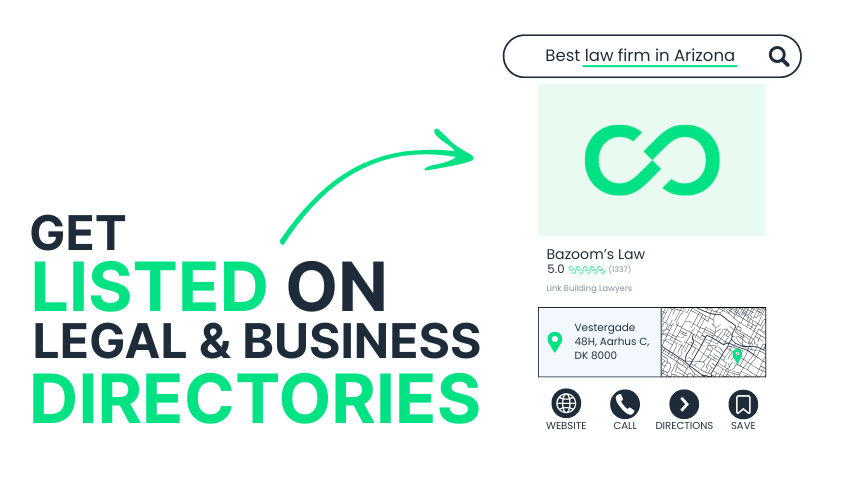
Essential directory optimization elements:
-
Complete business information with consistent NAP (Name, Address, Phone)
-
Detailed practice area descriptions with relevant keywords
-
Professional headshots and firm photos
-
Client reviews and testimonials where permitted
-
Links to specific practice area pages rather than just homepage
Local business directories and chamber of commerce listings provide geographic relevance signals crucial for local SEO. Law firms serving specific cities or regions should maintain profiles on:
-
Google Business Profile
-
Yelp for Business
-
Better Business Bureau
-
Local chamber of commerce directories
-
City and county bar association directories
Bar association directories and professional organizations offer some of the most authoritative backlinks available to legal professionals. These links carry significant weight with search engines due to the editorial oversight and professional standards required for membership.
Advanced Link Building Techniques
Once you’ve mastered foundational link building strategies, advanced techniques can accelerate your law firm’s authority building and competitive positioning. These approaches require more strategic planning and resource investment but often yield higher-quality backlinks from authoritative sources.
Scholarship link building campaigns leverage educational institutions’ need for funding while earning valuable .edu backlinks. Law firms can establish annual scholarships targeted at law students, pre-law undergraduates, or students pursuing degrees related to their practice areas. The scholarship pages created by universities typically include do-follow links back to the sponsoring law firm’s website.
Successful scholarship campaigns typically involve:
-
Annual scholarship amounts of $1,000-$5,000 to attract university attention
-
Clear eligibility criteria tied to your practice area (e.g., scholarships for students interested in environmental law)
-
Application requirements that demonstrate genuine educational value
-
Partnerships with law schools and undergraduate programs in your geographic region
Link reclamation for unlinked brand mentions identifies opportunities where your law firm is mentioned online without an accompanying link. Tools like Google Alerts can monitor for mentions of your firm name, key attorneys, or unique legal services you provide.
The reclamation process involves:
-
Setting up monitoring alerts for various name variations and misspellings
-
Identifying high-authority sites that mention your firm without linking
-
Reaching out to request link addition with helpful, non-pushy communication
-
Providing specific URL suggestions for the most relevant page to link
Digital PR campaigns for newsworthy legal events create opportunities for widespread media coverage and multiple high-authority backlinks. These campaigns work best when your law firm has genuine news value through significant case victories, expert analysis of legal developments, or unique legal insights on current events.
Effective digital PR approaches include:
-
Offering expert commentary on breaking legal news in your practice area
-
Publishing original legal research or survey data relevant to current events
-
Announcing significant case victories or settlements (when legally permissible)
-
Providing local media with expert analysis on legal implications of local news events
Resource page link building on educational sites targets law schools, legal aid organizations, and educational institutions that maintain lists of legal resources for students, faculty, or the public. These resource pages often link to helpful legal tools, guides, and professional services.
To succeed with resource page link building:
-
Identify .edu and .org sites that maintain legal resource directories
-
Create genuinely useful resources that merit inclusion on educational lists
-
Craft personalized outreach explaining how your resource benefits their audience
-
Focus on providing value rather than explicitly requesting links
Tools and Resources for Legal Link Building
Effective link building campaigns require the right tools for identifying opportunities, managing outreach, and measuring results. Here’s a comprehensive overview of essential tools and how to use them effectively for legal industry link building.
Essential SEO tools for backlink analysis:
Ahrefs provides the most comprehensive backlink database and analysis tools for legal professionals. Key features for law firms include:
-
Site Explorer for analyzing competitor backlink profiles
-
Content Explorer for finding legal publications that accept guest posts
-
Backlink gap analysis to identify opportunities competitors have secured
-
Alert features for monitoring new mentions and links to your firm
SEMrush offers strong competitive analysis and keyword research alongside backlink tracking. Particularly useful features include:
-
Backlink Audit tool for identifying potentially harmful links
-
Link Building Tool for finding and managing outreach opportunities
-
Position tracking for monitoring ranking improvements from link building efforts
-
Brand monitoring for identifying unlinked mentions
Moz provides user-friendly tools particularly valuable for smaller law firms. Key capabilities include:
-
Link Explorer for basic backlink analysis and opportunity identification
-
Spam Score analysis to evaluate link quality
-
Keyword Explorer for identifying link-worthy content topics
-
Local SEO tools for managing directory listings and local citations
Free tools that provide significant value:
Google Search Console offers essential insights into your current backlink profile and helps identify which links are driving the most valuable traffic. Regular monitoring shows:
-
Which sites are linking to your law firm
-
Which pages receive the most backlinks
-
Search queries that drive traffic from linked sites
-
Any manual penalties or issues affecting your site
Google Analytics tracks the business impact of your link building efforts by showing:
-
Referral traffic from specific linking sites
-
Conversion rates from different traffic sources
-
User behavior and engagement from linked visitors
-
Goal completions and lead generation from referral traffic
Measuring Link Building Success
Tracking the right metrics ensures your link building efforts contribute to actual business growth rather than just vanity statistics. Legal professionals need to measure both SEO improvements and business outcome
s to justify continued investment in link building campaigns.
Key performance indicators for law firm link building:
Referring domains growth measures the number of unique websites linking to your law firm. Quality matters more than quantity, but consistent growth in referring domains from relevant legal sources indicates successful relationship building and content creation efforts.
Target benchmarks:
-
2-5 new referring domains per month for solo practitioners
-
5-10 new referring domains per month for mid-size firms
-
15+ new referring domains per month for large firms with dedicated marketing teams
Organic traffic increases show the business impact of improved search rankings. Track traffic growth to specific practice area pages rather than just overall website traffic to understand which link building efforts drive the most valuable visitors.
Monitor these organic traffic metrics:
-
Total organic sessions to practice area pages
-
Organic traffic from target geographic regions
-
Time on page and engagement metrics for linked visitors
-
Conversion rates from organic traffic to contact forms or phone calls
Keyword ranking improvements demonstrate progress toward competitive search positions.
Focus on tracking rankings for:
-
Primary practice area keywords with commercial intent
-
Local search terms combining location and legal services
-
Long-tail keywords that indicate specific legal needs
-
Branded keywords to monitor reputation management
Setting up proper tracking in Google Analytics:
Configure Google Analytics to specifically measure link building impact:
-
Create custom segments for referral traffic from linking sites
-
Set up goals for contact form submissions, phone calls, and consultation requests
-
Use UTM parameters for guest post and PR campaign links to track specific initiatives
-
Configure enhanced e-commerce tracking if your firm sells legal products or services online
Monitoring brand mentions and link attribution:
Track both linked and unlinked mentions of your law firm to understand your complete online presence:
-
Set up Google Alerts for your firm name, key attorney names, and unique service offerings
-
Monitor social media mentions across platforms like LinkedIn, Twitter, and Facebook
-
Track the sentiment and context of mentions to gauge reputation impact
ROI calculation methods for link building investments:
Calculate link building ROI by comparing investment costs against business outcomes:
Direct ROI calculation:
ROI = (Revenue from link building - Cost of link building) / Cost of link building × 100

Example:
- Link building costs: $5,000/month
- New clients acquired through improved rankings: 3 clients
- Average client value: $8,000
- Monthly revenue increase: $24,000
- ROI: ($24,000 - $5,000) / $5,000 × 100 = 380%
Long-term value considerations:
-
Compound effect of improved domain authority on future rankings
-
Reduced need for paid advertising as organic visibility improves
-
Enhanced credibility leading to higher conversion rates
-
Referral opportunities from industry relationships built through link building
Common Link Building Mistakes to Avoid
Understanding what not to do prevents costly mistakes that can harm your law firm’s online presence and waste valuable marketing resources. The legal industry’s emphasis on ethics and credibility makes certain link building mistakes particularly damaging.
Over-optimized anchor text patterns
Using identical keyword-rich anchor text for multiple backlinks creates an unnatural pattern that search engines flag as manipulative. Natural link building results in diverse anchor text that includes brand names, generic phrases, and varied keyword combinations.
Warning signs of over-optimization:
-
More than 60% of backlinks using exact-match keyword anchor text
-
Repetitive phrases like “personal injury lawyer” across multiple links
-
Lack of branded anchor text using your firm’s name
-
No variation in anchor text from different types of linking sites
Focusing on quantity over quality
Pursuing large numbers of low-quality backlinks provides little SEO value and can actually harm your rankings. Search engines evaluate the overall quality and relevance of your backlink profile, making a few high-authority links more valuable than dozens of low-quality ones.
Quality indicators to prioritize:
-
Editorial placement within relevant content rather than directory-style listings
-
Links from sites with engaged audiences and regular content updates
-
Contextual relevance between the linking site’s content and your legal services
-
Natural link placement that makes sense for readers
Ignoring relevance and context
Links from completely irrelevant websites provide minimal value and can appear suspicious to search engines. A backlink from a cooking blog to a personal injury attorney’s website lacks logical context and doesn’t signal topical authority.
Relevance factors to consider:
-
Industry alignment between linking site and your legal practice
-
Geographic relevance for local SEO benefits
-
Audience overlap between the linking site’s readers and your potential clients
-
Content context that naturally supports the link placement
Neglecting to disavow toxic backlinks
Low-quality or spammy backlinks pointing to your site can harm your rankings even if you didn’t create them. Competitors or SEO attacks can create negative backlinks, making regular monitoring and disavowal essential.
Signs that toxic backlinks need disavowal:
-
Links from sites with obvious spam content or adult material
-
Sitewide links from irrelevant foreign language websites
-
Links with exact-match anchor text from low-authority sites
-
Sudden spikes in backlinks from suspicious sources
Use Google’s Disavow Tool cautiously and only after attempting to remove harmful links through direct contact with website owners.
Conclusion
The legal industry’s digital transformation has made quality backlinks essential for law firm success. Clients increasingly rely on search engines to find legal services, making your law firm’s online visibility a direct factor in business growth and sustainability.
Effective link building for lawyers goes beyond technical SEO tactics. It’s about building genuine relationships with the legal community, establishing thought leadership through valuable content, and creating digital endorsements that reflect your firm’s expertise and credibility. The strategies outlined in this guide provide a roadmap for developing authoritative online presence that attracts clients and referrals.
The key to sustainable success lies in focusing on ethical, white-hat strategies that provide real value to the legal community. Whether you’re creating comprehensive legal guides, building relationships with legal journalists, or optimizing your presence in professional directories, every link building effort should strengthen both your search rankings and professional reputation.
Remember that link building is a long-term investment that compounds over time. The relationships you build today with legal publications and professional organizations will continue providing opportunities for coverage and citations throughout your career. The authoritative content you create now will attract backlinks and establish expertise for years to come.